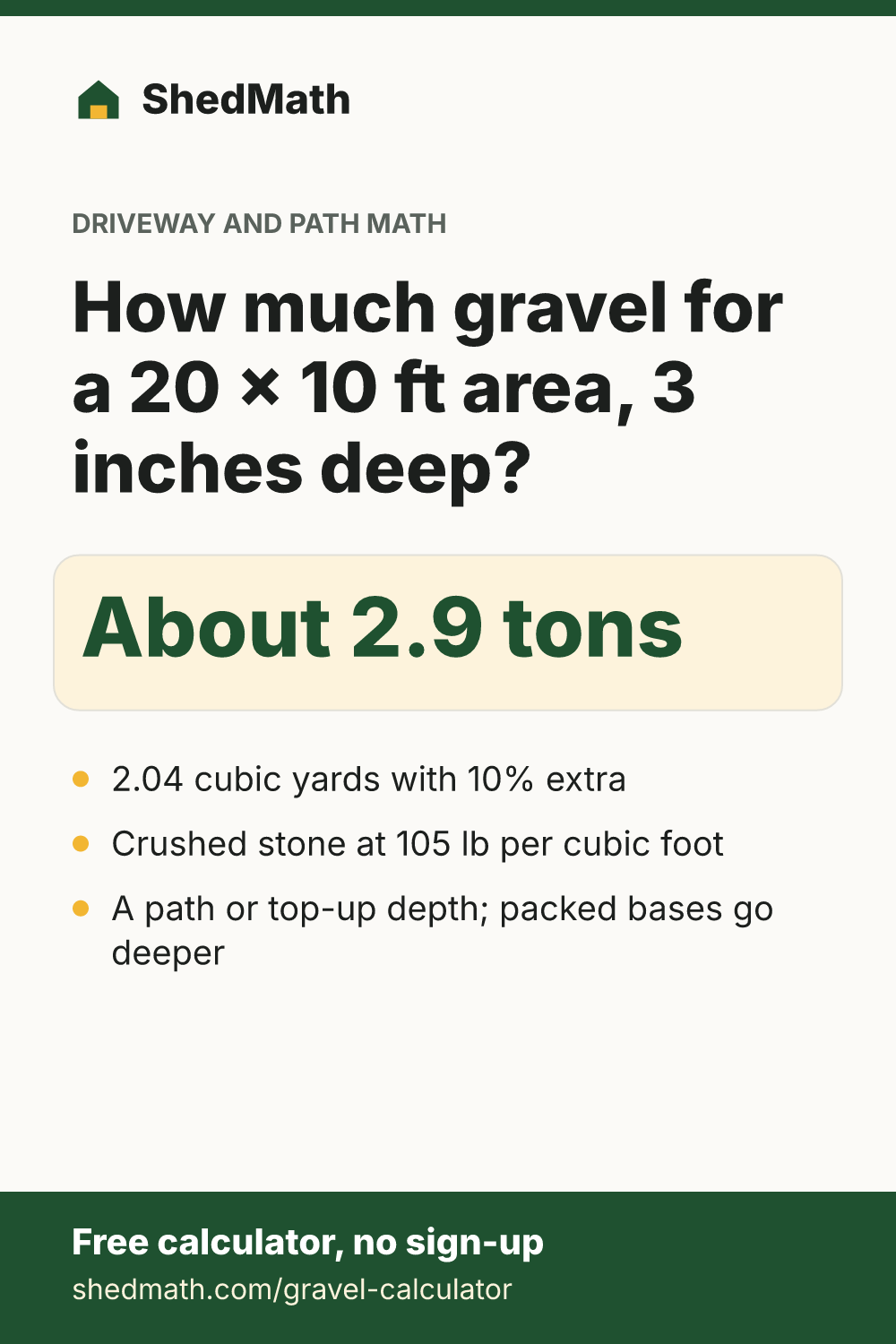
Gravel for a 20 × 10 ft area, 3 inches deep, works out to about 2.9 tons (2.04 cubic yards) with 10% extra. Give it your own area and depth and you'll get cubic yards and tons of gravel, crushed stone, pea gravel or sand.
Quick answers
Dry gravel weighs about 105 lb per cu ft, so one cubic yard is about 2,835 lb, roughly 1.4 tons (Engineering ToolBox).
One cubic yard covers about 162 sq ft at 2 in deep, 108 sq ft at 3 in and 81 sq ft at 4 in.
Unilock's guide calls for 6 to 8 in of compacted base under patios and walkways, and 10 to 14 in under paver driveways.
How to use the gravel calculator
Get the length and width in feet, or the diameter if the area is round.
Enter the finished depth in inches. If the gravel is a base you'll pack with a compactor, enter the depth after packing and choose a compaction allowance. Quikrete's patio base starts as 5 inches of loose gravel and tamps down to 4 (25% more), and Penn State's road surface goes down 8 inches to end at 6 (33% more).
Pick the material. If your supplier gives you a weight per cubic yard or per ton, choose Custom weight and enter it in pounds per cubic foot.
Add a price per ton or per cubic yard to estimate the cost.
The formula
Volume in cubic feet is area (sq ft) × depth (in) ÷ 12. Divide by 27 for cubic yards (the cubic yard calculator does just that conversion, with feet and inches mixed). Weight is cubic feet times the material's weight per cubic foot, and tons are pounds divided by 2,000.
Default weights come from Engineering ToolBox: about 105 lb per cubic foot for dry gravel, 125 for wet gravel, 97 for dry sand and 119 for wet sand. Real loads vary with rock type and moisture, which is why the custom field exists.
Worked example: a 20 × 10 ft area, 3 inches deep
200 sq ft × 3 ÷ 12 = 50 cubic feet, or 1.85 cubic yards. At 105 lb per cubic foot that's 5,250 lb, or 2.6 tons. With 10% extra, order about 2.9 tons (2.04 cubic yards).
Gravel needed for common projects
Dry gravel at 105 lb per cubic foot, no extra added.
Project
Cubic yards
Tons
10 × 10 ft area, 2 in deep
0.62
0.87
10 × 20 ft patio base, 4 in deep
2.47
3.5
3 × 50 ft path, 3 in deep
1.39
1.97
12 × 40 ft driveway, 4 in deep
5.93
8.4
12 × 60 ft driveway, 6 in deep
13.33
18.9
Save this example
The worked example as a card you can save to Pinterest or print.
Common questions
How many square feet does a ton of gravel cover?
At 2 inches deep, one ton of dry gravel (about 0.7 cubic yards) covers roughly 114 square feet. At 4 inches it covers about 57 square feet. Stone types weigh different amounts; see our chart of what a yard of gravel weighs by type.
How deep should gravel be for a driveway?
Penn State's dirt and gravel road bulletin spreads 8 inches of loose surface stone that packs down to 6. A home driveway is usually built in layers; see our guide to gravel for a driveway or patio base. Unilock's 10 to 14 inches is for the base under a paver driveway, not a gravel one. For which stone goes on top and which goes underneath, see the best gravel for a driveway.
Should I order by the ton or by the yard?
Use whatever your supplier sells by. This calculator shows both, so you can compare quotes. If they sell by the ton, the weight of their specific material matters, so enter it in the custom weight field for a closer answer.
The site only keeps what it needs to work, like your light or dark theme. With your OK we'd also count visits and, later, show ads that help keep the calculators free. Those stay off unless you say yes.How we use cookies