How to use the retaining wall calculator
- Run a tape along the face of the wall for its length. If it curves, lay a garden hose along the curve and measure the hose.
- Enter how tall the wall will stand above the finished ground, and how deep the first course sits below it.
- Pick your block, or enter the face height and length from the supplier's sheet. Depth into the hill doesn't change the block count.
- Leave the gravel settings at their defaults unless your block maker's guide says otherwise.
The formulas
Courses = (height above ground + buried depth) ÷ block height, rounded up. Blocks per course = wall length (in) ÷ block length, rounded up. Blocks = courses × blocks per course, plus the extra.
Footing = length × footing width × footing depth. Drainage gravel = length × drainage width × (built height − 3 in), because Western Interlock fills the drainage zone to within 3 in of the top and caps it with soil. Weights use 105 lb per cu ft for dry crushed stone (Engineering ToolBox). If your supplier quotes a weight, go with theirs.
Worked example: a 20 ft garden wall, 2 ft tall
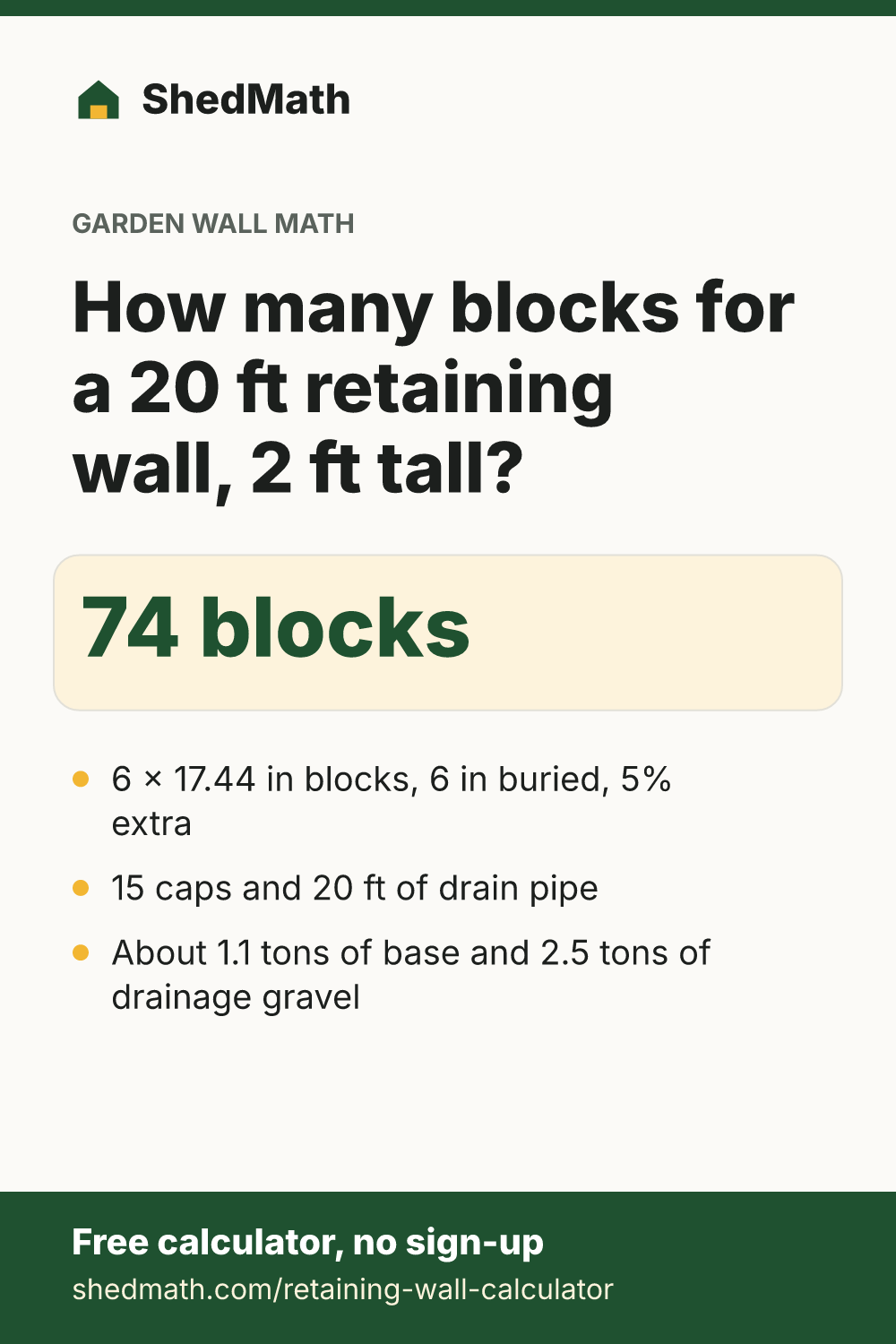
With 6 in buried, the wall is 30 in of block. Using 6 in tall Pavestone RockWall Large blocks, that's 5 courses. Each course is 240 in ÷ 17.44 in = 13.8, so 14 blocks. 5 × 14 = 70 blocks, and with 5% extra you buy 74 blocks and 15 caps.
The footing is 20 ft × 2 ft × 0.5 ft = 20 cu ft, or about 1.1 tons with extra. The drainage zone is 20 ft × 1 ft × 27 in = 45 cu ft, about 2.5 tons with extra. You'll also need 20 ft of perforated drain pipe.
Blocks per 10 ft of wall
Height above ground, with 6 in buried. No extra added.
| Block | 12 in tall | 24 in tall | 36 in tall |
|---|---|---|---|
| Pavestone RockWall Large, 6 × 17.44 × 7 in | 21 | 35 | 49 |
| Pavestone RockWall Small, 4 × 11.63 × 6.75 in | 55 | 88 | 121 |
| Belgard Diamond Pro, 8 × 18 × 12 in | 21 | 28 | 42 |
Before you dig
Call 811 before you dig so buried utility lines get marked. A trench for a retaining wall is long and deep enough to hit one.
Water trapped behind a wall adds its own pressure on top of the soil's, so the drainage gravel and pipe matter as much as the blocks. Keep the drainage zone clean stone, not soil or sand. And compact every layer of the footing: Ware Landscaping calls poor compaction one of the most common reasons retaining walls fail.