How much a yard of #57, crusher run or pea gravel weighs
A loose cubic yard of gravel weighs 2,400 to 3,200 lb, or 1.2 to 1.6 tons, on the charts of the stone sellers we read on October 15, 2026. Where it lands depends on the stone and on who’s selling it. Our gravel calculator assumes 2,835 lb (about 1.42 tons), and so do Omni’s and Stone Center’s. #57 stone is lighter. The Tennessee Department of Transportation uses 2,619 lb for it, and a Virginia supply yard says about 1.2 tons.
We read the charts of eight stone sellers, the Tennessee DOT’s design guidelines and three general reference tables, keeping only sellers that print a number for a named product.
#57 stone runs lighter than the default
Five sources print six figures for #57, and all six sit below 2,835 lb a yard:
- Acors Topsoil & Mulch, Fredericksburg, VA: “approximately 1.2 tons” (2,400 lb)
- A True Value bulk #57 limestone listing: 1.25 tons (2,500 lb)
- Smoky Mountain Sand & Gravel, Maryville, TN: 2,600 lb
- Tennessee DOT Roadway Design Guidelines (revised March 2015), section 4-303.00: 2,619 lb loose
- Dirt Connections, a contractor in Fairfax, VA: 2,410 lb, and further down the same page “approximately 1.4 tons” (2,800 lb)
That 1.4 tons is the only figure near the default. Dirt Connections’ own worked example sides with its lighter number, though: 2.5 cubic yards comes to 2.98 tons, which is about 1.19 tons a yard.
Against Tennessee’s 2,619, the 2,835 default is about 8% heavy. Against Acors’ 1.2 tons, about 18%. Order #57 by the ton from the default and you’ll likely get more stone than the volume you asked for. That’s the safe direction, but you pay for it. Ask your yard first. Use its weight per loose yard if it has one. If it can’t tell you, 97 lb per cubic foot (Tennessee’s 2,619 lb divided by 27, the heaviest clear number in that list) is what we’d type into the calculator’s Custom weight box. Keep the 10% extra on, since one seller we read does print 1.4 tons.
Every figure we found, by stone
| Stone | Who prints it | Per loose cubic yard | Tons per yard | Lb per cu ft |
|---|---|---|---|---|
| #57 stone | Acors Topsoil & Mulch | About 1.2 tons | 1.2 | 89 |
| #57 limestone | True Value listing | 1.25 tons | 1.25 | 93 |
| #57 stone | Smoky Mountain Sand & Gravel | 2,600 lb | 1.3 | 96 |
| #57 stone | Tennessee DOT | 2,619 lb | 1.31 | 97 |
| #57 stone | Dirt Connections | 2,410 lb, and “approximately 1.4 tons” | 1.2 or 1.4 | 89 or 104 |
| Crusher run (2 in minus) | Gravelshop | 2,410 lb | 1.21 | 89 |
| Crusher run | Smoky Mountain Sand & Gravel | 2,800 to 3,000 lb | 1.4 to 1.5 | 104 to 111 |
| Crusher run, road base | Select Sand & Gravel | Up to 3,000 lb | 1.5 | 111 |
| Mineral aggregate base | Tennessee DOT | 2,900 lb | 1.45 | 107 |
| Pea gravel | Smoky Mountain Sand & Gravel | 2,600 lb | 1.3 | 96 |
| Pea gravel | Mulch Mound | 2,500 to 2,700 lb | 1.25 to 1.35 | 93 to 100 |
| Pea gravel | Stone Center, Columbus and Cincinnati, OH | 1.2 to 1.4 tons | 1.2 to 1.4 | 89 to 104 |
| River rock | Smoky Mountain Sand & Gravel | 2,600 lb | 1.3 | 96 |
| River rock, 1 to 3 in | Mulch Mound | 2,800 to 3,000 lb | 1.4 to 1.5 | 104 to 111 |
| River rock, 3 to 5 in | Mulch Mound | 1.2 to 1.3 tons | 1.2 to 1.3 | 89 to 96 |
| River rock | Stone Center | 1.3 to 1.6 tons | 1.3 to 1.6 | 96 to 119 |
Tons convert at 2,000 lb, and the last column is pounds per cubic yard divided by 27, the unit the Custom weight box in our gravel calculator takes.
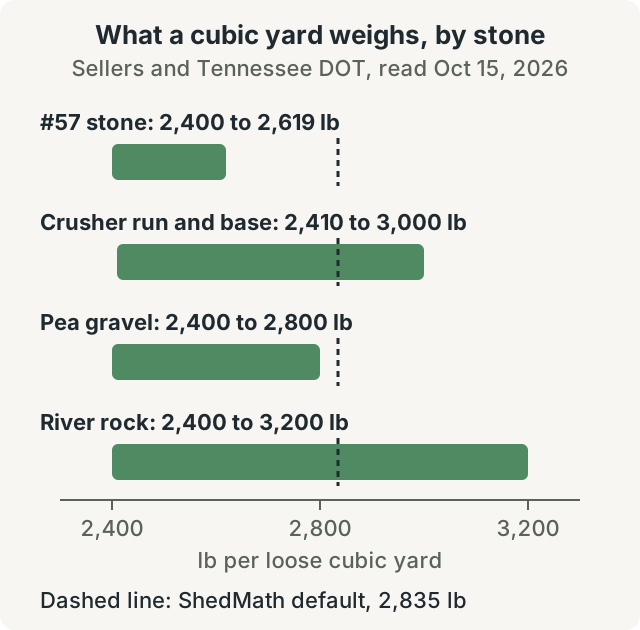
River rock spans the widest range, 2,400 to 3,200 lb, partly because it’s sold in so many sizes. Crusher run is close behind for one product name: Smoky Mountain’s top figure of 3,000 lb is 24% more than Gravelshop’s 2,410. Select Sand & Gravel says crusher run gets that heavy because its fines fill the gaps between the stones. Smoky Mountain’s chart adds only that density “varies a bit depending on moisture content, exact size mix, and how tightly the material is packed.” At 3,000 lb, the 2,835 default leaves you about 5.5% short on volume. At 2,410 it gives you about 18% extra.
Water adds weight too. Caterpillar’s material density tables put loose 1/4 to 2 inch gravel at 2,850 lb a yard dry and 3,400 wet. Buy a wet load by the ton and some of what you pay for is water.
Where the 2,835 lb default comes from
We couldn’t trace it to one origin, only to the number it matches. Engineering ToolBox lists dry gravel at 105 lb per cubic foot, and 105 times 27 is 2,835. Stone Center calls exactly 2,835 lb “a standard value”. Our gravel calculator uses 105 for dry gravel, pea gravel and river rock, and so did Omni’s when we tested 32 online calculators on October 10.
General tables disagree too. Caterpillar’s 2,850 is for 1/4 to 2 inch gravel, but the plain “Gravel, dry” row in the same table says 2,550. A truck-body weight chart hosted by the Two Rivers-Ottauquechee Regional Commission lists dry 3/4 inch gravel at 2,565 lb and crushed stone at 2,700. It credits “the EPA & NTEA” without naming a document.
Ordering for a packed base
Everything above is loose stone, as it sits in the truck. Road building guides also print weights per compacted yard, and those are much higher.
Tennessee’s guidelines take 2,900 lb per loose yard of mineral aggregate base, multiply it by 1.4, and come to 2.03 tons per compacted cubic yard. For #57 the same section multiplies its 2,619 lb by 1.02 for stone placed uncompacted (1.34 tons per yard) and by 1.14 when it’s compacted (1.49). The Penn State Center for Dirt and Gravel Road Studies has you order its driving surface aggregate at 0.04 tons per square foot when 8 inches loose packs to 6. By our math that’s 1.62 tons per loose yard, or 2.16 per finished yard.
Run those on a 12 by 20 foot base packed to 4 inches, the same pad from our calculator test. That’s 2.96 cubic yards packed.
| How it’s figured | Tons to order |
|---|---|
| Tennessee DOT, 2.03 tons per compacted yard | 6.0 |
| Penn State, 2.16 tons per finished yard (our math) | 6.4 |
| Our gravel calculator: compacted +25%, 10% extra | 5.8 |
| Our gravel calculator: cautious +33%, 10% extra | 6.1 |
Our +25% compacted setting comes in under both road figures. Theirs are for road bases built to a compaction spec: Penn State’s bulletin wants 95 to 100% of maximum dry density in the ASTM D698 lab test. A backyard pad packed with a rented plate compactor rarely gets a density test, so we can’t tell you which line yours will match. For a base you’ll drive on, we’d pick the +33% setting. It lands between the two road numbers.
By the ton or by the yard
Dirt Connections’ page says #57 is “generally sold by the ton”. Southwest Stone Supply in Osage Beach, Missouri works in yards instead: its calculator answers in “Total Yards Needed”, and it caps gravel deliveries at 15 cubic yards a truckload. Acors does both. It sells by the yard, or by the ton on bulk deliveries of 6 tons or more. When you buy by the yard, the weight only matters for what your truck or trailer can carry.
When you buy by the ton, the yard’s own weight for your product goes in the Custom weight box of the gravel calculator, along with your size and depth. The retaining wall calculator also uses 105 lb for its base and drainage gravel, so scale its tons by your yard’s weight divided by 2,835 if you’re buying #57 for the drainage zone. Depths by project are in our gravel base guide.