We tested 32 online calculators on one patio, base and mulch bed
Eleven online calculators sized the same 10 by 10 foot patio on October 10, 2026, and their answers ran from 55.42 to 62 bags of 80 lb concrete. That patio was one of three jobs we put through 32 calculators. Nine of them put one gravel base at anywhere from 3.4 to 5.04 tons.
The volumes weren’t the problem. Every volume the calculators showed matched ours before their extras, give or take rounding. The spread came from the steps after them: bag yield, stone weight, packing and defaults.
The raw results are in a CSV file, one row per calculator, so you can check any line below.
The scorecard
| Concrete patio | Gravel base | Mulch bed | |
|---|---|---|---|
| Job | 10 x 10 ft, 4 in thick | 12 x 20 ft, packed to 4 in | 20 x 5 ft, 3 in deep |
| Volume | 33.33 cu ft (1.23 cu yd) | 80 cu ft (2.96 cu yd) finished | 25 cu ft (0.93 cu yd) |
| What to buy, by our math | 56 bags of 80 lb, before extra | 3.70 cu yd loose | 13 bags of 2 cu ft |
| Calculators that gave a result | 11 | 10 | 11 |
| Matched our “what to buy” by default | 6 | 0 | 4 |
Where the “what to buy” row comes from: Quikrete’s data sheet for Concrete Mix 1101 says an 80 lb bag “yields approximately 0.60 ft3”, and 33.33 ÷ 0.60 = 55.6, so 56 bags. Quikrete’s patio instructions spread about 5 inches of compactible gravel and tamp it to 4, so a packed base takes 25% more stone than its finished size. The mulch is plain arithmetic. It’s 12.5 bags, and nobody sells half a bag.
Concrete: 55.42 to 62 bags for one patio
Six calculators said 56 bags of 80 lb. That matches the data sheet. Four gave a different count, and CalculatorSoup only does volume.
| Calculator | 80 lb bags | Extra included |
|---|---|---|
| Inch Calculator | 56 | None |
| Quikrete | 56 | None |
| Sakrete | 56, or 62 with 10% | Shows both |
| Concrete Network | 56 | None |
| Good Calculators | 56 | None |
| Housecall Pro | 56 | None |
| Calculator.net | 55.42 | None |
| Lowe’s | 57 | None stated |
| Omni Calculator | 62 | 0% (its default) |
| ConcreteCalculator.tools | 62 | 10% (its default) |
| CalculatorSoup | Volume only | None |
Omni gets to 62 with its waste setting at 0%. It multiplies the volume by a default density of 2,400 kg per cubic meter (Omni gives this as 150 lb per cubic foot) and divides that weight by the bag weight: 4,994 lb ÷ 80 = 62.4, shown as 62. Omni’s page puts an 80 lb bag at “approximately 0.53 cubic feet”, where Quikrete’s sheet says 0.60. So Omni’s 62 already carries about 12 to 13% extra concrete. Add your own 10% on top, as five of these pages suggest, and you’re paying for the extra twice.
Calculator.net works by weight too, at 133 lb per cubic foot, and shows 55.42 bags without rounding. Read it as 55 and you’re short. Lowe’s says 57 bags “of QUIKRETE”, one more than Quikrete’s own calculator gives for the same 33.33 cubic feet. Its page doesn’t say where the extra bag comes from.
Gravel: by default, none adds enough for a packed base
Ten gravel calculators ran, and before their own extras every one works out to 2.96 cubic yards for the 12 by 20 foot base. Two show it as a round 3.
If you’re topping up a pea gravel path, 2.96 is your answer. A base you’ll run a plate compactor over needs more, because packed stone takes up less room than loose. Quikrete’s 5 inch to 4 inch rule makes it 3.70 cubic yards. A Penn State Center for Dirt and Gravel Road Studies bulletin places its road aggregate 8 inches deep and compacts it to 6, which would make it 3.95.
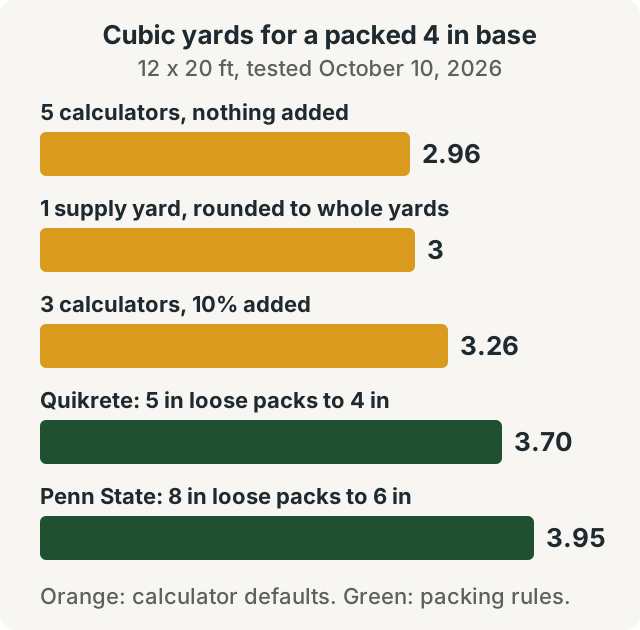
Four of the ten add something by default. Gravelshop puts a fixed “+15% compression” on its tons. Infinity Calculator, Stone Center and Eartheasy add 10%, and Eartheasy labels its 10% “compaction & spillage”. That’s the right idea, but the most generous of the four still lands about 8% under Quikrete’s rule. Take the plain 2.96 to the yard and your base finishes closer to 3.2 inches than 4.
CalculatorSoup and Infinity both have a compaction setting, and Infinity’s hint says crushed stone road base needs “about 40% more”. Inch Calculator’s page says you may need another 30% for compaction, on top of the 10% it suggests. The advice is there. The settings start blank or switched off, though, and so does ours: our gravel calculator starts on loose with 10% extra, which gives the same 3.26 as Infinity, Stone Center and Eartheasy.
Tons spread even wider, because each calculator assumes a different weight for a cubic yard of stone.
| Calculator | Weight it used | Tons shown |
|---|---|---|
| The Calculator Site | 85 lb per cu ft | 3.4 |
| Gravelshop (crusher run) | 2,410 lb per cu yd | 3.57, then 4.11 with its 15% |
| CalculatorSoup (#57 stone) | 2,431 lb per cu yd | 3.6 |
| Infinity Calculator | 100 lb per cu ft | 4.00 (4.40 with its 10%) |
| Omni Calculator | 105 lb per cu ft | 4.195 |
| Calculator.net | Not stated (about 105 lb per cu ft by our math) | 4.2 |
| Eartheasy (#57 stone) | About 100 lb per cu ft | 4.40, with its 10% |
| Stone Center | 2,835 lb per cu yd | 4.63, with its 10% |
| Inch Calculator | 1.4 to 1.7 tons per cu yd | 4.15 to 5.04 |
Stone really does vary in weight with its size, its type and how wet it is, so a range is honest. The gap is still big. Stone Center’s weight puts 2.96 cubic yards at about 4.2 tons before its extra; The Calculator Site says 3.4. Order by the ton from the lower number and you’d be about 0.8 tons short of the higher. Your yard knows what its own product weighs per yard, and that figure beats all nine of these.
Mulch: easy math, odd defaults
All eleven mulch calculators came out at about 25 cubic feet, shown as 0.9 to 0.93 cubic yards, except Zadlock Garden & Landscape Supply, which shows 1 cubic yard with no note about rounding.
The defaults don’t agree. CalculatorSoup’s depth box loads at 6 inches, while its own advice says 2 to 3 inches for fine mulch and 3 to 4 for coarse. Minor’s Garden Center loads at 1 inch, below the 2 to 4 inches its page says most mulches go on at. LandscapeCalculator.com also starts at 1 inch and gives no depth advice. Change only the size, hit calculate, and you’ve priced a bed that’s far thinner or deeper than intended.
Inch Calculator, CalculatorSoup, Lowe’s and Mahoney’s Garden Center round 12.5 bags up to 13. Omni and LandscapeCalculator.com show 12.5 and leave the rounding to you. Lowe’s rounds its 2 cubic foot bags up but shows 8.3 bags of the 3 cubic foot size.
None of the eleven adds extra for settling or uneven edges, even on pages whose text recommends it (Inch Calculator says 10%, CalculatorSoup 5 to 10%).
LawnStarter’s and Lawn Love’s calculators gave no result when we tried them. They share one widget, the Calculate button did nothing, and bits of template code showed on the page as text. Scotts and GreenScapes Garden Center couldn’t be run either: we found no calculator on Scotts’ site, and GreenScapes’ widget never loaded.
Four pages that disagree with themselves
On these pages, the text and the page’s own numbers don’t match:
- Inch Calculator’s concrete page says 75 bags of 50 lb fill a cubic yard, which is 0.36 cubic feet a bag. Its calculator returns 89 of those bags for our 1.23 yards, which fits 0.375. One line also says “45 90-lb bags” where its own table says 45 bags of 80 lb.
- Housecall Pro’s concrete page gives the formula as “total cubic yards * cubic yards per bag”, which should be a division, and its 40 lb example reads “3.70 * .011 = 366 bags”. 3.70 ÷ 0.011 is 336.4, so 337 bags. The 60 and 80 lb lines of the same example print a * too but get the division right (218 and 168), so this looks like a slip.
- The Calculator Site’s gravel result is labelled “For gravel (loose, dry) with density of 85lb/ft3”, while the article under it says “we assume a density of 1.41 tons/yd3”. At 1.41, our base comes to about 4.2 tons, not 3.4.
- Mahoney’s Garden Center’s tip says a 100 square foot bed at 3 inches needs “about 0.75 cubic yards, or roughly 13.5 bags”. Its calculator says 0.93 cubic yards and 13 bags for that bed. The calculator is right.
How we tested
We tried 44 calculator pages on October 10, 2026, in a Chrome browser, and 32 of them gave a result. Five were blocked: Home Depot (concrete, gravel and mulch), Menards and Angi. Seven couldn’t be run, either because the site has no calculator for that job (The Calculator Site for concrete, Lowe’s and Good Calculators for gravel, Scotts for mulch) or because it didn’t work (LawnStarter, Lawn Love, GreenScapes). The 32 come from 23 sites; Omni, Inch Calculator, Calculator.net and CalculatorSoup each appear three times.
For each one we entered the job and left the other settings alone, with two exceptions noted in the CSV: we picked the bag size where the result needed it, and where a tool asked for a material or defaulted to pea gravel, we chose #57 stone, crusher run, or a hardwood or bark mulch. We copied down what each result showed and any assumption the page stated.
It’s not a random sample. We chose the big general calculator sites, the bag makers Quikrete and Sakrete, Lowe’s, and garden centers and supply yards we found through web search. We tested from outside the US, and for us Omni and Calculator.net opened in metric units, which we switched to feet and inches before entering anything. They may open differently for you. Calculators also get updated, so read this as a one-day snapshot.
We build calculators too, so weigh our part of this with the same care. Our concrete calculator uses Quikrete’s 0.60 yield and adds a 10% extra you can see and change. Our gravel calculator has Quikrete’s and Penn State’s packing rules as settings, though it starts on loose with 10% extra. The mulch calculator rounds bags up and starts at 5% extra.
Three checks before you order
- Concrete: find the bag yield the calculator assumes. If it’s below 0.60 cubic feet for an 80 lb bag, as Omni’s weight method works out to, the count already has padding, so don’t add more. If the page doesn’t say, compare its answer for this patio with 56 bags.
- Gravel for a packed base: if there’s no compaction setting, type in your finished depth times 1.25.
- Mulch: set the depth yourself. Round bags up.
Or put your own size into the concrete, gravel or mulch calculator, and for a gravel base pick the packed setting. Earlier, smaller checks are in our posts on bags of concrete in a yard, gravel calculators and compaction and mulch calculator depths.