How much gravel do you need for a driveway or patio base?
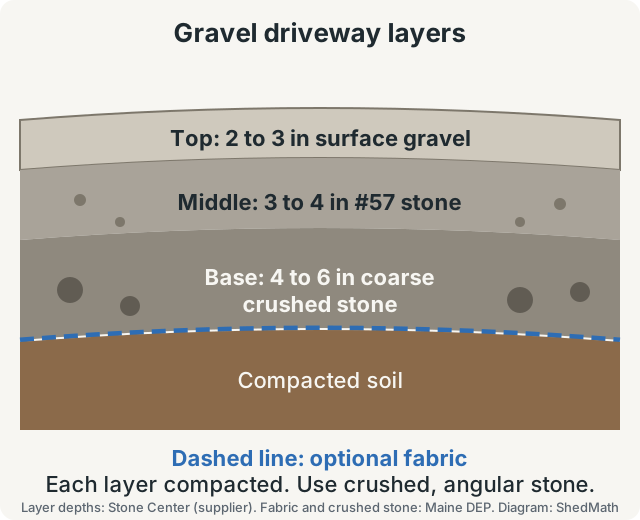
A paver patio needs at least 4 inches of compacted base, and a paver driveway at least 6, per the Concrete Masonry and Hardscapes Association (CMHA). Concrete patios need about 4 inches. Stone Center, a gravel supplier, builds a plain gravel driveway 8 to 12 inches deep in three layers.
CMHA’s and Quikrete’s depths are finished depths, measured after the gravel’s packed down. Belgard and Unilock don’t say either way, and Stone Center gives its driveway layers as the depth you spread. Loose gravel shrinks when you compact it, so to hit a finished depth you’ll order 25 to 33% more.

Base depth by project
| Project | Base depth | Source |
|---|---|---|
| Paver patio or walkway | 4 in minimum on well-drained soil | CMHA |
| Paver patio or walkway | 4 to 6 in | Belgard, Oregon State Extension, Unilock’s DIY page |
| Paver patio or walkway | 6 to 8 in | Unilock’s Basic Tech Guide |
| Paver driveway | 6 in minimum on well-drained soil | CMHA |
| Paver driveway | 8 to 12 in | Belgard, Unilock’s DIY page |
| Paver driveway | 10 to 14 in | Unilock’s Basic Tech Guide |
| Concrete patio | 4 in (5 in loose, tamped down) | Concrete Network, Quikrete |
| Gravel driveway | 8 to 12 in in three layers, spread depth | Stone Center (a gravel supplier) |
The CMHA numbers are minimums for good, well-drained soil. Unilock publishes two sets of numbers: its DIY page says 4 to 6 inches for walkways and 8 to 12 for driveways, and its Basic Tech Guide for installers says 6 to 8 and 10 to 14. When a maker’s own documents differ, we’d build to the thicker one on anything but well-drained soil.
Gravel driveways are harder to pin down, because the public guides are written for roads. Maine’s Department of Environmental Protection calls for a 12 to 18 inch compacted base on camp roads. So the 8 to 12 inch, three-layer recipe here comes from one supplier, Stone Center. We couldn’t find a university or government source written for home driveways.
Why you order more than the finished depth
Gravel shrinks when packed. Quikrete’s patio instructions start with 5 inches of loose gravel and tamp it down to 4. Penn State’s Center for Dirt and Gravel Road Studies places its road surface 8 inches deep to end up with 6.
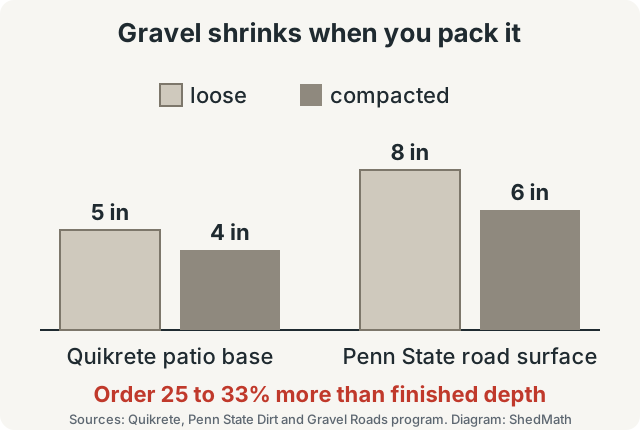
So you need 25% more in one case and 33% more in the other. Order exactly the finished volume and you’ll run short. Two examples don’t prove a floor. If a second trip to the yard would ruin your weekend, order the extra third.
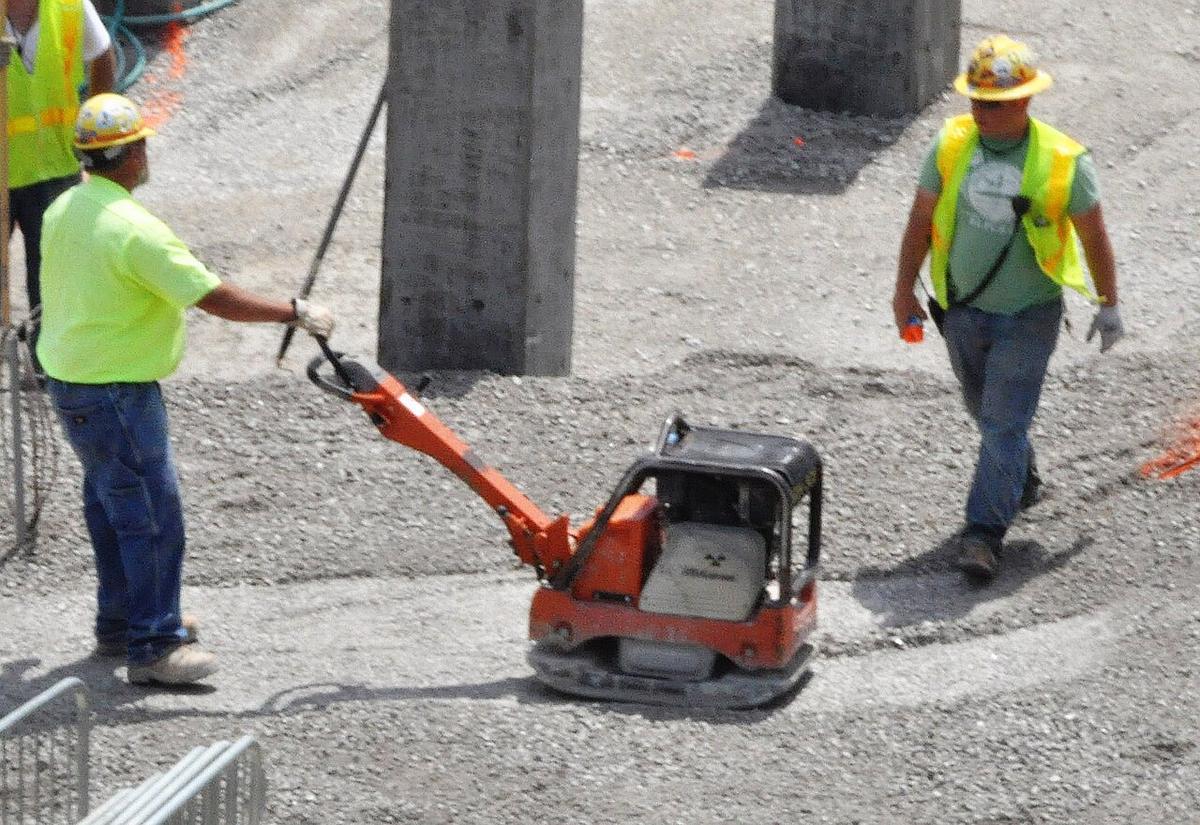
Pack it in layers. Unilock’s DIY page says most ordinary plate compactors won’t pack more than about 4 inches, so compact in 3 to 4 inch layers; its tech guide goes thinner, 2 to 3 inches. CMHA allows 4 to 6 inch layers, but only with a heavy 7,000 lbf reversible plate compactor, so check what your rental counter has first.
,_compactor.jpg)
Worked example: a 12 x 50 foot driveway
A single-lane driveway, 12 feet wide and 50 feet long, is 600 square feet. Stone Center’s three layers at the thin end are 4 inches of base, 3 inches of #57 stone and 2 inches of surface gravel. It gives those as spread depths. We treat them as packed depths here, which is the cautious reading, and add 25% for compaction:
| Layer | Finished depth | Compacted volume | Loose volume to order | Tons |
|---|---|---|---|---|
| Base: coarse crushed stone | 4 in | 7.41 cu yd | 9.26 cu yd | 13.1 |
| Middle: #57 stone | 3 in | 5.56 cu yd | 6.94 cu yd | 9.8 |
| Top: surface gravel | 2 in | 3.70 cu yd | 4.63 cu yd | 6.6 |
| Total | 9 in | 16.67 cu yd | 20.83 cu yd | 29.5 |
Tons use 105 pounds per cubic foot, Engineering ToolBox’s figure for dry gravel, which is about 1.42 tons per cubic yard. That’s just above the 1.35 to 1.4 that Select Sand & Gravel, a Texas and Oklahoma aggregate supplier, gives for crushed stone, and under the 1.5 it says crusher run can reach. If your yard sells by the ton, ask what their product weighs per yard and use that.
Use crushed stone, not round stone
Round gravel rolls. Crushed stone has broken, angular faces that lock together when you pack it. Maine DEP’s road manual says to buy crushed gravel rather than bank-run gravel (rounded stone dug from a pit), because the crushed edges lie flat and pack well. It also describes what happens with the rounded kind: tires roll the stones out of the surface and leave holes.
Maine’s manual also explains how the layers differ. The base is mostly larger stone with only a little fine material (silt and clay), so water drains through it. The top layer carries more fines, which bind the surface into a hard crust.
Do you need landscape fabric underneath?
Sometimes. On soft, poorly drained soil, it helps. Maine DEP says fabric under the base keeps fine soil from mixing up into the stone, and should be covered with at least 6 inches of compacted material. Penn State’s bulletin says fabric is allowed but not required. On firm, sandy soil you can probably skip it. On clay that stays wet, we’d put it down.
A paver patio base, worked out
For a 12 x 12 foot paver patio built on CMHA’s 4 inch minimum base, with a bed of sand on top, the order looks like this:
- Base: 48 cubic feet compacted. With 25% extra, order about 60 cubic feet, which is 2.22 cubic yards or about 3.2 tons.
- Bedding sand: CMHA, Belgard and Oregon State Extension all say about 1 inch, screeded flat. CMHA says to leave it uncompacted. That’s 12 cubic feet, or 0.44 cubic yards.
The paver calculator does both layers and the paver count in one go, but it doesn’t add for compaction, so enter the loose base depth (finished depth times 1.25).
What it costs
Prices swing with your region and how far the truck drives. HomeGuide (December 2025) lists crusher run at $24 to $34 per ton and delivery at $10 to $25 per ton, or free with a 5-ton minimum order within 5 miles.
At HomeGuide’s crusher-run prices, the 29.5 tons for the example driveway works out to roughly $710 to $1,000 before delivery. If you take Stone Center’s depths as spread depths and skip the compaction allowance, it’s 16.67 cubic yards, about 23.6 tons, or roughly $570 to $800. Your top stone may cost more per ton than the base, so get a quote per layer.

For a 10 x 20 foot pad, the 10 x 20 gravel page lists the cubic yards at common depths.
Once you’ve picked a depth for each layer, run them one at a time through the gravel calculator with compaction at 25% (set the extra to 0 if you want to match the table above). You’ll get cubic yards, tons and the loose depth to spread. The 12 x 50 driveway page has common depths done already. If you’re pouring concrete instead, the slab planner lists the base for you.