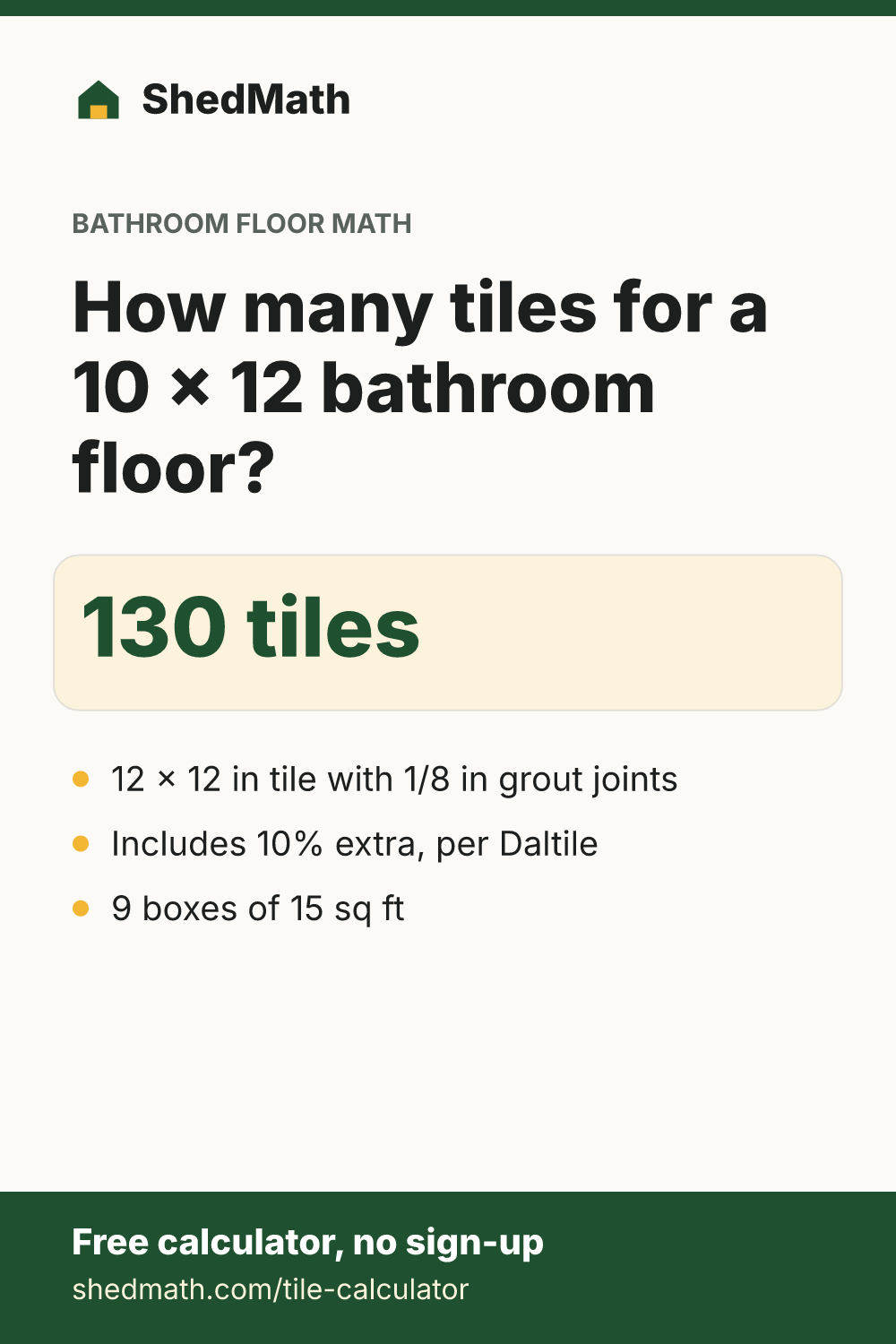
Buy 130 tiles, or 9 boxes of 15 sq ft, for a 10 × 12 ft floor in 12 × 12 in tile with 1/8 in joints and 10% extra. Add your own room and tile size to get tiles, boxes, grout and thinset.
Quick answers
A 25 lb bag of sanded grout covers about 383 sq ft of 12 × 12 × 3/8 in tile with 1/8 in joints, but only 94 sq ft with 1/2 in joints (MAPEI Keracolor S chart).
A 50 lb bag of thinset covers about 75 to 90 sq ft with a 1/4 × 1/4 in square-notch trowel and 55 to 65 sq ft with a 1/4 × 3/8 in trowel (MAPEI Ultraflex 2).
How to use the tile calculator
Take the floor or wall size in feet. For L-shaped rooms, add the rectangles with the square footage calculator and enter the total.
Enter the tile's real size in inches, as printed on the box, and the grout joint you plan to use.
Add the square feet per box from the label to get a box count. For plank, laminate or vinyl floors sold by the box, the flooring calculator also works out underlayment and baseboard.
The formulas
Tiles = area (sq ft) × 144 ÷ ((tile length + joint) × (tile width + joint)), plus the extra, rounded up.
Grout volume = area × (tile length + tile width) ÷ (tile length × tile width) × joint width × tile thickness × 144 cubic inches. MAPEI's Keracolor S coverage chart works out to about 430 cubic inches per 25 lb bag in every row, so we divide by 17.2 to get pounds.
Thinset uses the low end of MAPEI Ultraflex 2's published coverage, so you're less likely to run short. Laying planks instead of tile? The flooring calculator counts boxes, underlayment and baseboard.
Worked example: a 10 × 12 ft bathroom floor
120 sq ft of 12 × 12 in tile, 3/8 in thick, with 1/8 in joints. Each tile plus joint covers 12.125 × 12.125 = 147 sq in, so 120 × 144 ÷ 147 = 117.5 tiles. With 10% extra, buy 130 tiles, or 9 boxes of 15 sq ft. Grout: about 8.6 lb, so one 10 lb bag or one 25 lb bag. Thinset: 132 sq ft ÷ 75 = 2 bags of 50 lb.
Tiles and grout per 100 sq ft
No extra added. Grout in pounds, sanded.
Tile
Joint
Tiles
Grout (lb)
3 × 6 in subway
1/16 in
776
8.2
6 × 6 in
1/8 in
384
8.7
12 × 12 in
1/8 in
98
6.5
12 × 24 in
1/8 in
50
4.9
24 × 24 in
1/8 in
25
3.3
Save this example
The worked example as a card you can save to Pinterest or print.
Common questions
How many tiles do I need for 100 square feet?
With 12 × 12 in tile and 1/8 in joints, each tile plus its joint covers about 1.02 sq ft, so 100 sq ft takes 98 tiles. Add 10% for cuts and breakage and buy about 108. For 6 × 6 in tile with 1/8 in joints it's about 384 tiles before the extra.
How much extra tile should I buy?
Daltile recommends buying about 10% more than you measure. Diagonal and herringbone layouts produce more offcuts, so order more for those. Keep a few spare tiles from the same lot for future repairs; colors can vary between production runs.
How much grout do I need?
Grout only fills the joints, so joint width, tile size and thickness set the amount. Smaller tiles and wider joints use much more. The calculator uses the coverage chart in MAPEI's Keracolor S data sheet: about 430 cubic inches of joint per 25 lb bag.
What size trowel should I use for tile?
Pick the notch that gives full mortar contact. Larger tiles need a bigger notch. Press a tile in, lift it and check the back. The tile and mortar instructions list the notch sizes they approve.
Does the joint width change how many tiles I need?
Slightly. Each joint adds to the space a tile covers, so wider joints mean fewer tiles. With 12 in tile, a 1/8 in joint saves about 2% of tiles compared with butting them tight. With small mosaic tile the effect is much bigger.
The site only keeps what it needs to work, like your light or dark theme. With your OK we'd also count visits and, later, show ads that help keep the calculators free. Those stay off unless you say yes.How we use cookies