How deep should mulch be? (And how many bags to buy)
Spread mulch 2 to 4 inches deep, and keep it pulled back from tree trunks. That’s the range from Penn State Extension and the University of Illinois Extension. The University of Maryland Extension is stricter and caps it at 3 inches.
Fine, shredded mulch should stay at the low end. Clemson’s Home and Garden Information Center says many wood and bark mulches are made of fine pieces and shouldn’t go past 2 to 3 inches. Clemson also says grass clippings or shredded leaves should never go deeper than 2 inches.
Why deeper is worse
Penn State explains that when the layer is too thick, air may not get through it and the soil below runs short of oxygen. Roots need that oxygen. Maryland’s extension agrees, and adds that a light watering may only wet the mulch while the soil under it stays dry. Illinois adds another risk: thick mulch keeps the soil from drying out, and too much moisture in the root zone can cause root rot.
Penn State also says to use less mulch if your soil drains poorly.
Keep it off the trunk
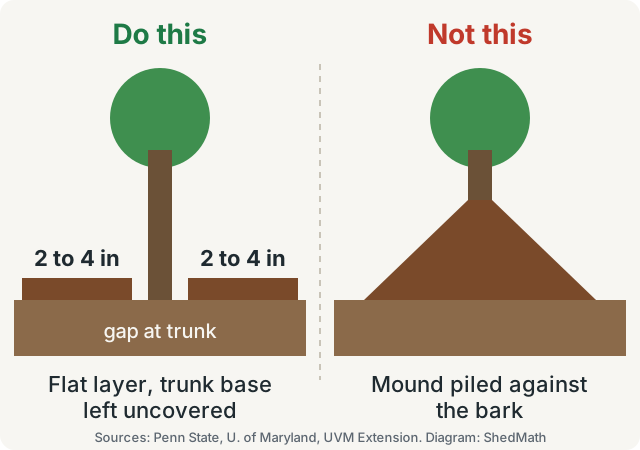
Penn State, Maryland and Clemson each give a different gap:
| Source | Gap between mulch and trunk or stem |
|---|---|
| Penn State Extension | 3 to 5 in for young trees, 8 to 10 in for mature trees |
| University of Maryland Extension | 3 in |
| Clemson HGIC | 2 to 3 in from woody plant stems |
The bark at the base of a tree or shrub shouldn’t sit against wet mulch, and all three say so. For a big, old tree, Penn State’s wider gap is the safer pick.
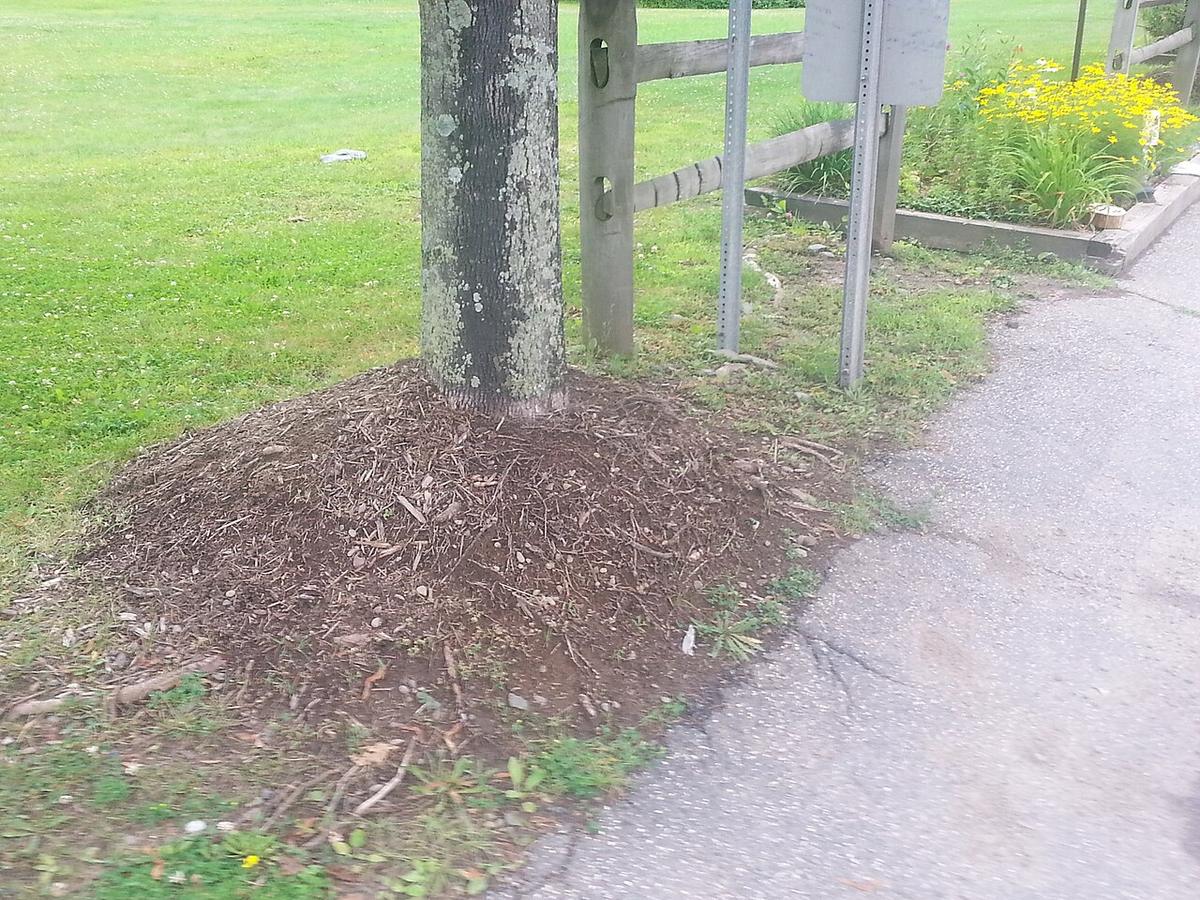
Don’t build a “mulch volcano,” which is mulch piled against the trunk in a cone. The University of Vermont Extension says it traps moisture against the bark, which invites decay, insects and disease. Penn State calls volcano mulching a cause of major tree health problems.
.jpg)
Topping up an old layer
You add 3 inches every spring because that’s the “right depth,” and after a few years the bed has 6 or 8 inches on it.
Penn State puts it plainly: new mulch over old mulch, year after year, is the same as putting down too thick a layer all at once. Some of the old mulch may need to come out first. Maryland says topping up is fine as long as the total stays at 3 inches or less.
So measure before you buy. Push a trowel or a ruler down through the old mulch until you hit soil and check the depth. If you’re aiming for 3 inches and 2 are left, you only need about 1 more.
For a 10 by 20 foot bed:
| What you’re doing | Cubic feet (with 5% extra) | Bags of 2 cu ft | Bags of 3 cu ft |
|---|---|---|---|
| New bed, 3 in deep | 52.5 | 27 | 18 |
| Topping up 1 in | 17.5 | 9 | 6 |
How often you’ll top up depends on the mulch. Clemson says pine needles and bark usually last around 2 to 4 years. Grass clippings and leaves break down fast and need replacing often.
How much mulch to buy
Bulk mulch is sold by the cubic yard. Bags come in cubic feet. One cubic yard is 27 cubic feet, so it equals nine 3 cu ft bags or 13.5 bags of 2 cu ft.
Clemson gives a handy rule: one cubic yard covers 324 square feet at 1 inch deep. From that, coverage per yard at each depth:
| Depth | Area one cubic yard covers |
|---|---|
| 1 in | 324 sq ft |
| 2 in | 162 sq ft |
| 3 in | 108 sq ft |
| 4 in | 81 sq ft |
For the 10 by 20 bed at 3 inches, that’s 200 square feet times 3, divided by 324: about 1.85 cubic yards, or 50 cubic feet. The mulch calculator adds 5% extra by default, which is where the 27 and 18 bags above come from. The 10 x 20 bed page shows the same bed at 2, 3 and 4 inches.
Nitrogen and dyed mulch
Nitrogen. Wood chips can tie up nitrogen in the soil as they break down, but Oregon State Extension says small particles like sawdust are more likely to do it than big chips, and chips mixed into the soil are more likely to do it than chips left on top as mulch. Clemson is more cautious: it says small wood chips rot quickly, use nitrogen from the soil, and that nitrogen then has to be replaced with fertilizer.
Dyed mulch. UMass Extension found no evidence that the dyes are toxic. Its concern is the wood underneath: most colored mulch is made from recycled wood, which can include construction waste and old treated lumber. If that bothers you, buy undyed mulch, or ask the seller what wood it’s made from.
If a new bed needs soil before the mulch goes on, the 10 x 10 topsoil page lists the cubic yards at common depths.
Measure your beds and what’s left of the old mulch. Then put the size and the depth you need into the mulch calculator.