Mulch or rock in a flower bed: what each takes over 10 years
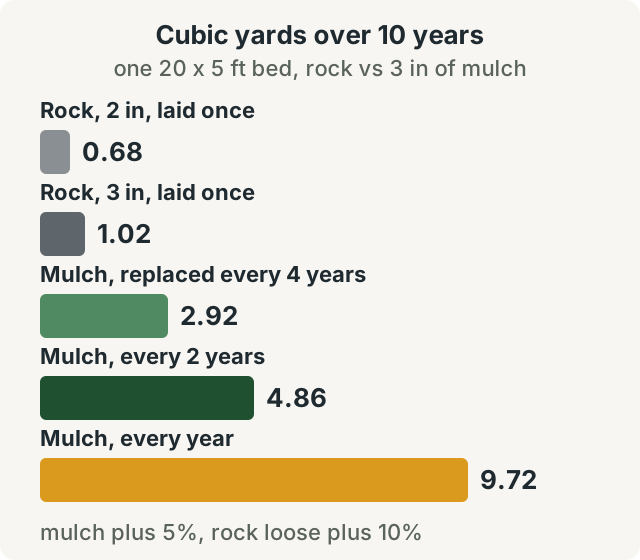
Over ten years, a 20 by 5 foot flower bed takes 0.68 cubic yards of small rock, put down once, or somewhere between 2.9 and 9.7 cubic yards of mulch, depending on how fast the mulch breaks down. Still, use mulch for flowers. Extension guides from Clemson, Nebraska and North Dakota State all warn that rock heats the bed, Clemson says it offers no benefit for soil health, and North Dakota State says it harms the soil.
The 20 by 5 foot bed is the default in our mulch calculator, so you can check every mulch number below by opening it. The rock numbers come from the gravel calculator with the same bed.
Ten years of one bed, both ways
The catch with mulch is how often it goes. Extension guides don’t agree on one number, so we worked out three intervals they give. Each time, it’s a full 3 inch layer with the mulch calculator’s default 5% extra: 26.25 cubic feet, or 14 bags of 2 cubic feet. Clemson’s 2 to 4 years is how long bark lasts “before the need to add more,” so every row counts the most a top-up could take.
| Full 3 in layer every | Based on | Layers in 10 years | 2 cu ft bags | Cubic yards |
|---|---|---|---|---|
| 4 years | Clemson: pine needles and bark “typically last for around 2 to 4 years” | 3 | 42 | 2.92 |
| 2 years | Clemson: wood chips “are usually completely decomposed within 2 years” | 5 | 70 | 4.86 |
| 1 year | UF/IFAS Alachua County, Using Mulch Effectively: organic mulches “will have to be replenished annually by placing a new layer of mulch on top” | 10 | 140 | 9.72 |
Rock goes in once.
| Rock layer | Depth | Cubic yards | Tons at 105 lb per cu ft | Bags of 0.5 cu ft |
|---|---|---|---|---|
| Stone 1/2 inch or smaller | 2 in | 0.68 | 0.96 | 37 |
| Stone 3/4 to 1 inch | 3 in | 1.02 | 1.44 | 55 |
| Stone 1 inch or larger | 4 in | 1.36 | 1.93 | 74 |
The depths are Home Depot’s: its decorative stone guide (updated April 5, 2024) says stone 1/2 inch or less goes 2 inches deep, 3/4 to 1 inch stone about 3 inches, and anything 1 inch or larger 4 inches. The same page says bagged stone “typically” holds about 0.5 cubic feet; the bag counts are our math, cubic feet divided by 0.5 and rounded up. Rock rows use the gravel calculator’s defaults: 105 lb per cubic foot and 10% extra, loose. Mulch Mound’s river rock page (June 8, 2026) lands in the same place, with 2 inches for “decorative ground cover in planting beds” and river rock “typically installed at two to three inches deep.”
Read the one-year row as a ceiling. It assumes the whole 3 inches is gone each spring, and in most beds it isn’t. Penn State Extension’s Mulching Landscape Trees warns that new mulch over old, year after year, is “the same as applying too deep a layer all at once,” so push a trowel down first and buy only what’s missing. Our mulch depth guide shows a 1 inch top-up on a 10 by 20 bed: 9 bags instead of 27.
Nebraska Extension’s Mulching the Landscape (EC1274, 2014) splits the difference. High quality wood mulch “may need only a light topdressing each year,” with “full replacement being necessary after two to four years.” Washington State University Spokane County Extension’s Guide to Mulches (C075, revised 2023) puts it at “every one to two years.”
The rock goes down in one heavy day
Less volume, more weight. The 2 inch rock layer weighs about 0.96 tons at the calculator’s default, and bought bagged that’s 37 bags at about 52.5 lb each (0.5 cubic feet times 105 lb, our math). Your stone may run heavier or lighter. Seller weights for each stone type are in what a yard of gravel weighs. The mulch is 14 bags a layer, carried in again every few years.
That weight lands on the roots. Tom Kalb of North Dakota State, in Choosing Mulch for Trees and Shrubs (2016), writes that rock mulch “harms the soil. Its heavy weight compacts the ground and destroys air pockets needed for roots to grow.”
What rock does to a planted bed
Stone gets hot. So does the bed around it. Clemson’s mulch fact sheet (HGIC 1604) says gravel and stone “reflect solar radiation and can create a very hot landscape environment during the summer months.” Kalb calls rock “a heat trap” that “will scorch plants during the summer and make plants uncomfortable in winter, too.” Nebraska’s guide says soil under rock warms up earlier in the year, which “can cause plants to break dormancy,” and it lists “higher levels of plant stress” among the results of the extra heat. Organic mulch works the other way. Clemson’s Samantha McGaha Brown, a horticulture agent, says it holds moisture, keeping the soil “cool during the summer and warm in the winter.”
In her January 2025 comparison of the two, Brown turns to the soil: organic mulch “will add nutrients to the soil” as it breaks down, while rock offers “no benefit for plant growth or soil health.” The Clemson fact sheet says not to use rock around acid-loving plants, “since the rocks may add alkaline elements and minerals to the soil.”
Leaves and grit collect between the stones. WSU’s guide says that debris “can accumulate on top of the rocks and unless removed will allow weed seeds to germinate,” and once weeds take hold, “it is hard to manually remove them.” It mentions gardeners using leaf blowers to keep the debris off. WSU calls black plastic or weed fabric under the rock “a more drastic measure” and adds, “We do not recommend this practice, however.”
Nebraska warns that inorganic mulches “can be difficult to remove when beds are renovated or eliminated.” For our small bed that’s 37 to 74 bags of stone to dig back out. The same guide says rock “can become dangerous projectiles thrown by mowers,” so think twice about a rock bed right at the lawn’s edge.
Where rock earns its place
Gravel and pebbles “rarely need replenishing,” per Clemson’s fact sheet, and the sheet points them at permanent plantings such as “foundation plants.” It says a 1 inch layer of small rocks “will provide good weed control.” Brown says it can help with erosion, since it will “stay in place on hillside/sloped yards.”
| Mulch | Rock | |
|---|---|---|
| Use it for | Flower beds and anything you’ll replant | A foundation strip or a slope you won’t dig again |
| Skip it for | A bed you want to set and forget | Acid-loving plants (Clemson) and beds under trees that drop leaves (debris on rock lets weeds in, per WSU) |
| Material over 10 years, 20 x 5 ft bed | 2.92 to 9.72 cu yd | 0.68 to 1.36 cu yd, once |
| Feeds the soil | Yes, as it breaks down | No |
| Upkeep | Measure and top up | Blow off debris, pull weeds from the stones |
Our call: rock only where nothing in the bed needs better soil and you’re sure you won’t change the bed. A strip of shrubs along the foundation is fine. Perennials are different. If you divide and move them every few years, stick with mulch and top it up after you measure.
Pricing your own bed
We left prices out, since we’d need dated quotes from named sellers to print any. Both calculators take your own. The mulch calculator has boxes for a price per bag and per cubic yard; multiply its answer by how many times you expect to replace the layer in the years you’re comparing. The gravel calculator takes a price per ton or per cubic yard, and that’s a one-time number.
Enter your bed and depth in the mulch calculator, then run the same bed through the gravel calculator, and line up the two totals.