Using it on a block wall
It's built for hollow 8 × 8 × 16 in concrete block, often called cinder block.
- Measure the wall's length along one face, and its finished height. For an L or U shape, measure one leg on the outside face and the next on the inside face so the corner isn't counted twice, and add them. Then say whether the wall has square ends.
- Choose the mortar you'll buy. The three options are Quikrete's bagged mortars, each with the block count from its own data sheet.
- Pick the core fill. Quikrete's block wall page calls for its Core-Fill Grout Coarse in cores over 4 in wide, and the bag counts here are for Coarse.
Why every other course gets half blocks
Courses (rows of block) = height ÷ 8 in, rounded up. Each course is laid in running bond, meaning each row is shifted half a block from the one below. So the calculator works in 8 in steps along the wall, and every other course starts with a half block at each square end. Length is rounded up to whole 8 in steps. An odd number of steps means every course takes one half block or one cut block. On a straight wall with no openings, you only cut block when the length isn't a multiple of 8 in. The count works from the total length, so on a closed shape or the middle leg of a U, a side that isn't a multiple of 16 in also needs a half block or a cut block in every course. The calculator doesn't add those; count one per course for each such side.
Doors and windows come off at 1.125 blocks per square foot. The half blocks you'd want beside an opening aren't added, and the bars inside an opening, with the cores grouted around them, aren't taken out, so adjust those yourself. With "Every core", the opening's cores do come off. Mortar bags = (blocks + half blocks) ÷ blocks per bag, plus the extra. We count a half block as a whole one there, our assumption, since Quikrete's figures are only for full blocks. Thirteen is Quikrete's "up to" figure for both Mason Mix and Mortar Mix, the most a bag lays. A bag can lay fewer, and the result doesn't include a spare bag.
Rebar = one bar per spacing along the wall. The first goes in the core nearest the end, about 4 in from it. The last bar can land short of the far end, so add one there if your plans call for a bar at each end. Each bar is as tall as the wall and is cut from 20 ft sticks (our assumption, the same default as our rebar calculator; check what your supplier stocks). With a footing, each bar also gets 6 in into it. That comes from Quikrete's rule for load-bearing walls (ones that carry a roof or floor): set the tie rods, the vertical bars, at least 6 in into the footing. We apply it to every wall. Grout per core = 0.65 cu ft ÷ (3 blocks × 2 cores), about 0.11 cu ft, from Quikrete's bag yield and our assumption of two cores per block. With "Every core", a half block counts as one core.
Footing concrete uses 0.6 cu ft per 80 lb bag (Quikrete Concrete Mix), and gravel 105 lb per cu ft (Engineering ToolBox).
Worked example: 24 ft of block, 4 ft high, two square ends
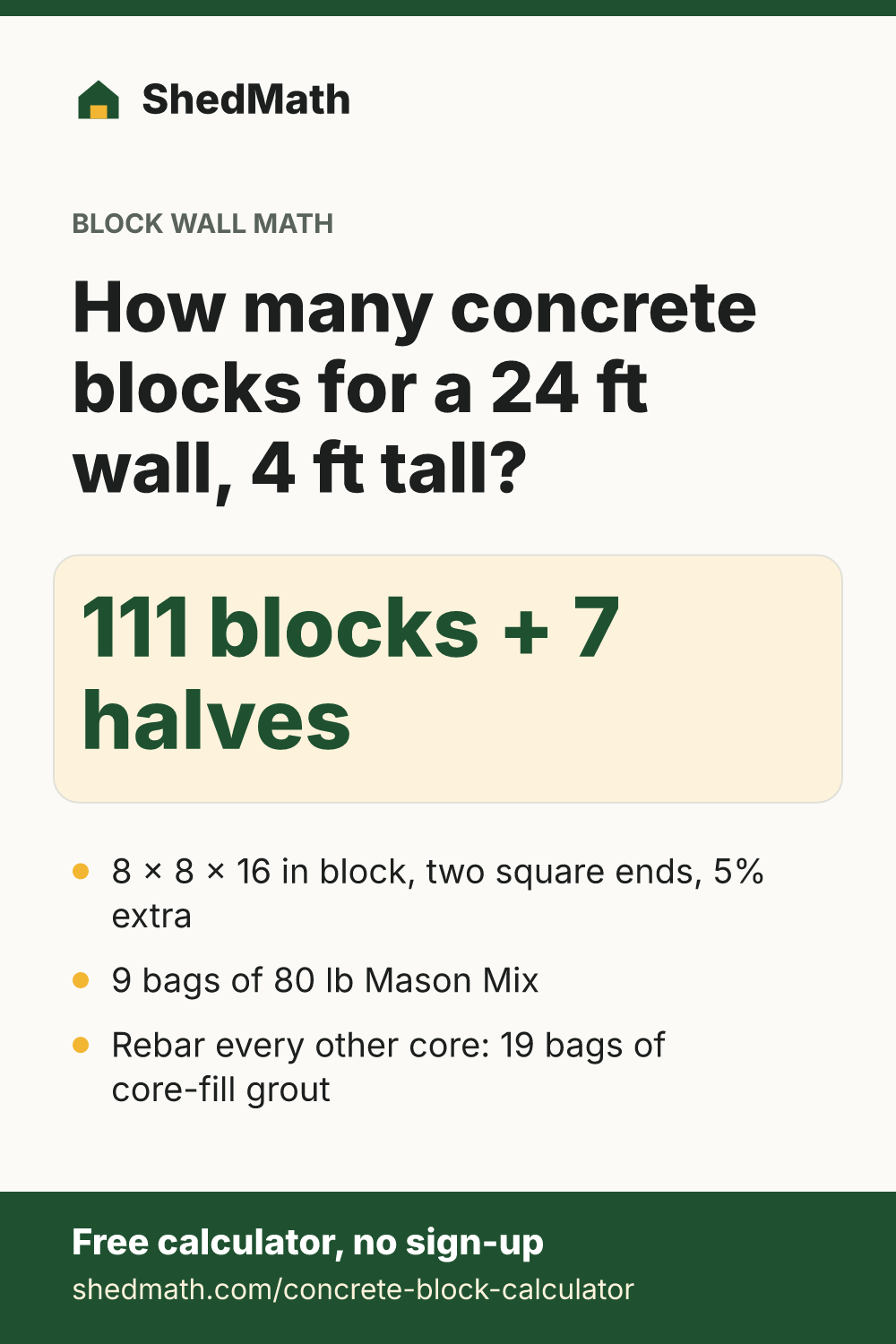
Four feet of 8 in block is 6 courses. Twenty-four feet is 36 steps of 8 in, an even number, so the 3 courses that start full take 18 blocks each and the 3 that start with a half block at each end take 17 blocks and 2 half blocks. That's 105 blocks and 6 half blocks, and with 5% extra you buy 111 blocks and 7 half blocks.
Mortar: 105 blocks and 6 half blocks make 111 pieces to lay (not counting the extra), ÷ 13 per bag of Mason Mix (Quikrete's "up to" figure), plus 5%, rounds up to 9 bags. Rebar every 16 in gives 18 bars of 4.5 ft (48 in of wall plus 6 in into the footing); 4 fit in a 20 ft stick, so that's 5 sticks. Those 18 bars run through 6 courses, so 108 cores get grout: 12.29 cu ft with the extra, or 19 bags of Core-Fill Grout.
The footing, 16 in wide and 8 in deep, is 22.4 cu ft with the extra: 38 bags of 80 lb concrete, or 0.83 cu yd. The 6 in of gravel under it is about 0.88 tons. That's 38 bags to mix by hand, which is a lot of mixing; we'd price a small load of ready-mix (concrete delivered by truck) in the concrete calculator before buying them.
Blocks and bags by wall height
For 10 ft of wall with two square ends, Mason Mix, and rebar every 16 in with those cores grouted. These counts leave out the footing and the 5% extra. Ten feet is an odd number of 8 in steps (15). So every course ends with one half block, alternating sides.
| Wall height | Blocks + halves | Mason Mix bags | Grout bags |
|---|---|---|---|
| 2 ft | 21 + 3 | 2 | 4 |
| 4 ft | 42 + 6 | 4 | 8 |
| 6 ft | 63 + 9 | 6 | 12 |
Cold weather and retaining walls
Check the forecast first. Quikrete's Core-Fill Grout sheet says not to pour if it's expected to drop below 40°F within 24 hours unless you take cold-weather precautions, to keep it above 50°F for at least 7 days, and to use each batch within an hour. The same sheet says to protect it from rain, snow and freezing for 48 hours, and to use plastic sheeting and insulation blankets if it's going below 32°F. Our guide to how cold is too cold to pour concrete covers the footing side of a fall build.
If the wall holds back soil, it's a retaining wall. If it holds back more than 48 in of soil and isn't braced at the top, or it's over 24 in tall with a driveway or other load pushing on it, the code's retaining wall section, R404.4 of the International Residential Code (IRC; the link is California's copy), says it "shall be designed in accordance with accepted engineering practice". That usually means an engineer's design. Our guide on how tall a retaining wall can be without an engineer walks through both lines and the permit rule. For a stacked garden wall with no mortar, the retaining wall calculator handles interlocking blocks and drainage gravel instead.