How to use this concrete calculator
- Pick the shape: a flat slab or patio, a footing or wall, or a round post hole or column.
- Put in length and width in feet and the thickness in inches. Any field can switch to inches, yards, meters or centimeters.
- If you're pouring several identical pieces, such as 8 fence post holes, set How many. For posts there's also a quick table of bags of concrete per fence post by post size and hole depth.
- The waste allowance starts at 10%. Lower it only if your forms are square and level.
Bags or a truck: what to actually order
The calculator rounds a ready-mix order up to the next quarter yard, because that's how plants sell it. Duke City Redi-Mix sells in quarter-yard steps with a one-yard minimum, and Schmitz Ready Mix tells customers to round up to the nearest quarter yard.
Small loads cost more per yard. A standard truck holds about 10 cubic yards (HomeGuide), and plants add a short-load fee below a set size. At Townsend Concrete in California, that threshold is 3 to 6 yards depending on the delivery zone, with a fee of up to $100. Duke City charges extra under 5 yards. Ask your plant for its numbers and put them in the cost box above.
Bags also mean lifting. Every 80 lb bag gets lifted, carried and mixed by hand, and the calculator shows the total weight so you can judge it.
Steps and L-shaped slabs
For solid steps poured on the ground, the bottom step is one riser tall, the next is two risers tall, and so on. Volume is width × run × rise × n × (n + 1) ÷ 2 for n steps. Three 7 inch steps with 11 inch treads, 4 ft wide, take about 12.8 cubic feet: 24 bags of 80 lb with 10% extra. If your steps sit on a platform or against a porch, add the platform as a slab. To find how many steps you need and each riser's height from the total rise, use the stair calculator.
For an L-shaped or irregular slab, split it into rectangles and add them as extra sections. The calculator adds up the areas and uses one thickness for all of them.
The formula
For a slab or footing, volume in cubic feet is length (ft) × width (ft) × thickness (in) ÷ 12. For a round column it's π × (diameter ÷ 2)² × height, with the diameter converted to feet first.
Divide cubic feet by 27 to get cubic yards, the unit ready-mix plants sell by. To get bags, divide cubic feet by the bag's yield and round up: about 0.60 cu ft for an 80 lb bag, 0.45 for 60 lb, 0.375 for 50 lb and 0.30 for 40 lb, per Quikrete's and Sakrete's published data. When we tested 32 online calculators, bag yield was one of the steps that made their answers differ.
Worked example: a 10 × 10 ft patio, 4 inches thick
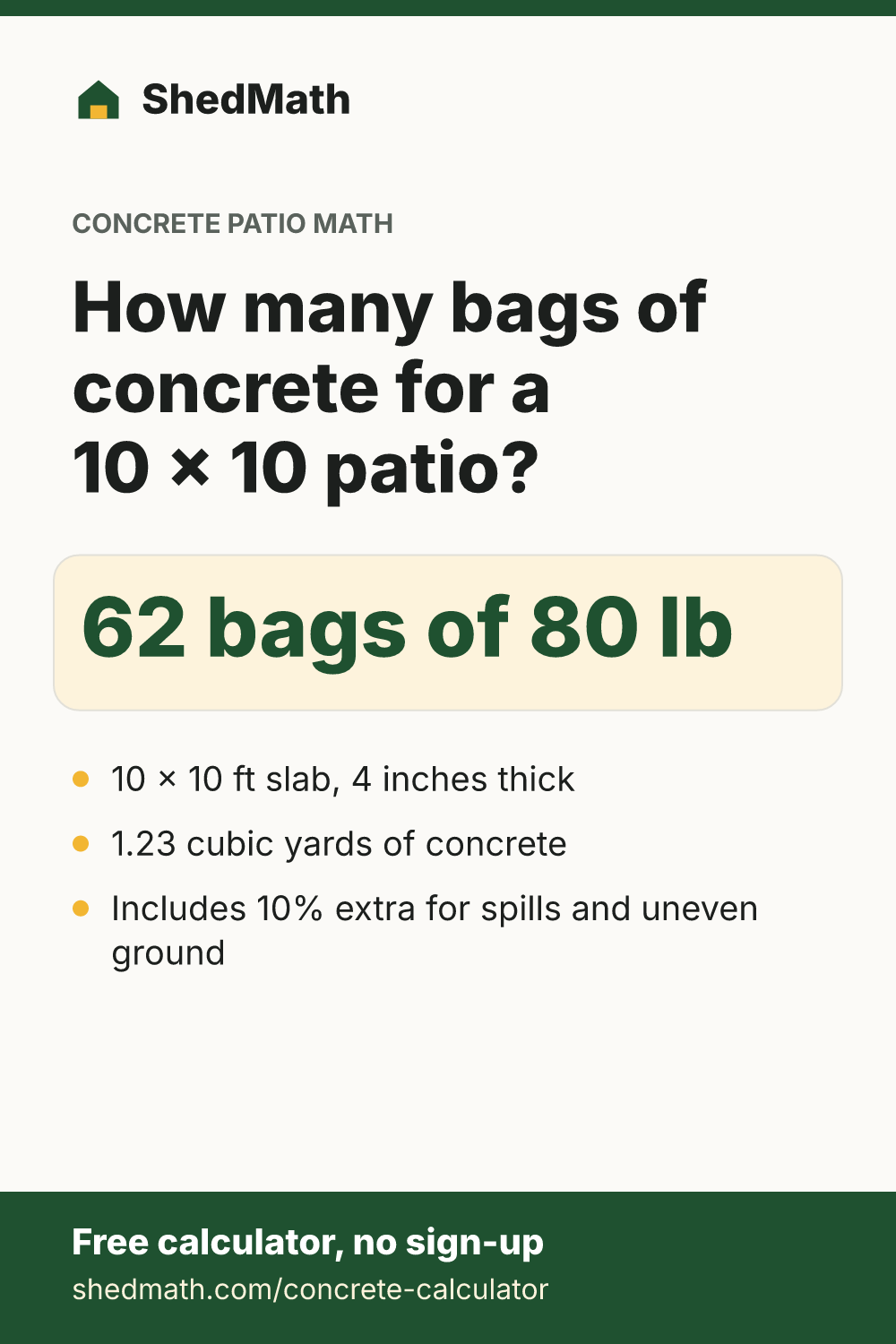
10 × 10 × 4 ÷ 12 = 33.3 cubic feet, which is 33.3 ÷ 27 = 1.23 cubic yards. Add 10% and you need 36.7 cubic feet. That's 36.7 ÷ 0.60 = 61.1, so buy 62 bags of 80 lb concrete.
Bags needed for common slab sizes
All rows assume a 4 inch thick slab, the usual patio minimum (see how thick a patio should be), with 10% extra. Open a size for 5 and 6 inch slabs, weight and the full math.
| Slab size | Cubic yards | 80 lb bags | 60 lb bags | 40 lb bags |
|---|---|---|---|---|
| 4 x 4 ft | 0.22 | 10 | 14 | 20 |
| 4 x 8 ft | 0.43 | 20 | 27 | 40 |
| 6 x 6 ft | 0.49 | 22 | 30 | 44 |
| 8 x 8 ft | 0.87 | 40 | 53 | 79 |
| 8 x 10 ft | 1.09 | 49 | 66 | 98 |
| 10 x 10 ft | 1.36 | 62 | 82 | 123 |
| 10 x 12 ft | 1.63 | 74 | 98 | 147 |
| 10 x 20 ft | 2.72 | 123 | 163 | 245 |
| 12 x 12 ft | 1.96 | 88 | 118 | 176 |
| 12 x 16 ft | 2.61 | 118 | 157 | 235 |
| 12 x 20 ft | 3.26 | 147 | 196 | 294 |
| 12 x 24 ft | 3.91 | 176 | 235 | 352 |
| 16 x 16 ft | 3.48 | 157 | 209 | 313 |
| 20 x 20 ft | 5.43 | 245 | 326 | 489 |
| 20 x 24 ft | 6.52 | 294 | 392 | 587 |
| 24 x 24 ft | 7.82 | 352 | 470 | 704 |
Tips before you pour
- Measure the forms, not the plan. Check the inside of the forms once they're set. An extra half inch of depth across a large slab adds up fast.
- Check local rules. Footing depth, slab thickness and reinforcement for structural work are set by your local building code.
- Pouring a footing for a block wall? The concrete block calculator sizes it from Quikrete's footing rule and counts the blocks, mortar and core-fill grout that go on top.
- Mind the weight. Concrete weighs roughly 140 to 150 lb per cubic foot (Engineering ToolBox). Sixty 80 lb bags is 4,800 lb. Check your truck's payload rating before you load up.