Crusher run on top, #57 underneath: the best driveway gravel
The best gravel for a driveway’s top layer is crusher run, or whatever your yard calls crushed stone with the stone dust left in. The dust packs into the gaps between the stones and the top sets up hard. Clean #57 stone belongs underneath it, where it drains. Pea gravel doesn’t belong on a driveway at all, because round stones roll out from under tires.
That’s the road manual answer. Public guides for landowners stack a gravel road that way, but a lot of stone yards sell the same two stones in the opposite order, with #57 on top, and that’s where the advice you’ll find online splits.
#57 on top, or underneath?
Ebyland, a Maryland supply yard, says #57 on top “drains well, locks together, and gives you a clean surface to drive on.” Maine’s gravel road manual says close to the opposite about crushed stone that’s one size with no fines: it “doesn’t pack well and moves around a lot under tires.” It calls that stone “good for road base material and to stabilize soft, flat parking areas,” and road base is where Virginia’s Culpeper Soil and Water Conservation District puts #57 too.
| Guide | What goes on top | What goes underneath | Pea gravel |
|---|---|---|---|
| Maine DEP gravel road manual (2016), for camp and private roads | Surface gravel with 7 to 12% fines | Base with no more than 7% fines | Doesn’t name it; says tires roll rounded bank-run stones out of the surface |
| Culpeper Soil and Water Conservation District, Virginia (2019), for private roadways | 6 inches of “fine gravel like VDOT #21A” | #57 “for strength and drainage” | Not mentioned |
| Penn State Center for Dirt and Gravel Road Studies (2025), for Pennsylvania’s dirt and gravel road program | Driving surface aggregate, 11 to 15% fines | Not covered | Not mentioned |
| Ebyland, Cumberland, MD (October 28, 2026) | #57 or #67 | Crusher run | “Round stones like pea gravel shift under tires” |
| Hello Gravel (December 2025) | 3/4 to 1 inch crushed stone | 1 1/2 inch crushed stone or crusher run | Shifts “easily under vehicle weight” |
| Zimmerman Mulch, Lebanon, PA (2025) | About 3/4 inch stone, decorative | “Modified” gravel up to 1.5 in, with fines | Listed for paths and play areas |
Pages as they read on November 4, 2026. The first three are written for people who maintain their own gravel roads, the other three are stone sellers that show up for driveway gravel searches. Fines are the silt- and clay-sized dust, measured as what falls through a No. 200 sieve. None of the six suggests pea gravel to drive on, and every one that names a base stone wants it crushed.
We side with the road manuals. They’re written for people who keep their own gravel roads drivable year after year, and they explain why each layer is what it is. #57 on top can work if you like the look, as long as you’re fine with stone that shifts.
What the fines do
#57 is a defined size, not a brand. ASTM D448, the standard that numbers stone sizes, sets it at 1 inch down to a No. 4 sieve (about 3/16 inch), with no more than 5% passing the No. 8 sieve. A copy of the table is posted by Bermuda’s government with a stone supply tender. In plain terms, it’s stone with almost no dust. Water runs straight through it, and nothing holds the stones to each other.
Crusher run has the dust. Select Sand & Gravel, a Texas and Oklahoma supplier, calls it “a mix of stone and stone dust designed for maximum compaction.” Penn State’s driving surface spec explains why that works. Its mix runs from 1 1/2 inch stone down to dust, with 11 to 15% passing the No. 200 sieve, and when it’s compacted the “Larger particles locked tightly in place by smaller particles and fines.”
You can see the difference in what the stone weighs once it’s packed. The Tennessee DOT design guidelines (revised March 2015, section 4-303.00) count a compacted cubic yard of mineral aggregate base as 2.03 tons and a compacted yard of #57 as 1.49. That’s 36% more weight in the same finished space. Tennessee starts from loose weights: 2,900 lb a yard for the base, multiplied by 1.4 for packing, against 2,619 lb for #57, multiplied by only 1.14. Most of the gap is the packing, because the fines fill the holes.
More dust isn’t better, though. Maine caps its surface gravel at 12% fines, and says plain stone dust “can become muddy in the spring since it doesn’t provide good drainage,” even though it packs well enough to use as a surface coat over driveways. The surface layer needs enough fines to bind and shed water, and the base underneath needs few enough to drain.
Names aren’t standard, so ask before you order. Ebyland calls #57 “roughly ¾ inch”, where ASTM’s top size is 1 inch, and describes crusher run as dust up to about 3/4 inch, while Gravelshop’s crusher run is 2 inch minus. Roanoke County, Virginia’s 2024 stone bid lists “#25 Crusher Run” in a clean and a dirty version, next to #21A as a separate item. Ask your yard for the biggest stone in the mix and whether the dust is in it.
Which stone for which job
| Crusher run (or a state base mix like 21A) | #57 stone | Pea gravel | |
|---|---|---|---|
| What it is | Crushed stone mixed with its dust | Crushed stone, 1 in to 3/16 in, almost no dust | Small, smooth stones, 3/8 in (Zimmerman) |
| Packs hard? | Yes | Barely: it moves under tires (Maine) | No: it shifts under tires (Ebyland, Hello Gravel) |
| Water | Sheds it off a crowned top (Maine) | Drains through (Culpeper) | Not covered by these guides |
| Best for | The driving surface, and the base | A drainage layer under the top; soft, flat parking areas (Maine) | Paths and play areas |
| Not for | Swapping for plain stone dust, which Maine says gets muddy | The top, if you want it to stay put | Any driveway |
Slopes favor fines. Hello Gravel suggests crusher run for sloped drives because it “compacts tighter and resists washing away.” Maine’s one good surface use for clean crushed stone is a parking area that’s soft and flat, not a sloped drive.
Tons for a 12 by 100 foot driveway
Here’s a long single-lane driveway, 1,200 square feet, built both ways. The road manual order follows Culpeper: 6 inches of fine crushed surface over a #57 base. Culpeper gives no base depth, so the 4 inches is our example, not a manual figure. The stone yard order uses the 6 inch base and 2 inch top that Ebyland passes on from Bob Vila. Tons come from Tennessee DOT’s factors: its mineral aggregate base figure of 2.03 tons per packed yard for the crusher run, 1.49 for packed #57 and 1.34 for #57 left loose (2,619 lb times 1.02), the figure Tennessee uses for uncompacted #57.
| Layer | Depth | Cubic yards | Tons |
|---|---|---|---|
| Road manual order | |||
| Top: crusher run, packed | 6 in | 22.2 | 45.1 |
| Base: #57, packed | 4 in | 14.8 | 22.1 |
| Total | 10 in | 37.0 | 67.2 |
| Stone yard order | |||
| Top: #57, loose | 2 in | 7.4 | 9.9 |
| Base: crusher run, packed | 6 in | 22.2 | 45.1 |
| Total | 8 in | 29.6 | 55.0 |
Our gravel calculator lands close on the crusher run layer: 6 inches packed with the cautious +33% compaction setting and its 10% extra comes to 46.1 tons at its default 105 lb per cubic foot. Penn State’s ordering formula, width times length times 0.04 for 8 inches loose packed to 6, gives 48.0. Order on the high side of those three.
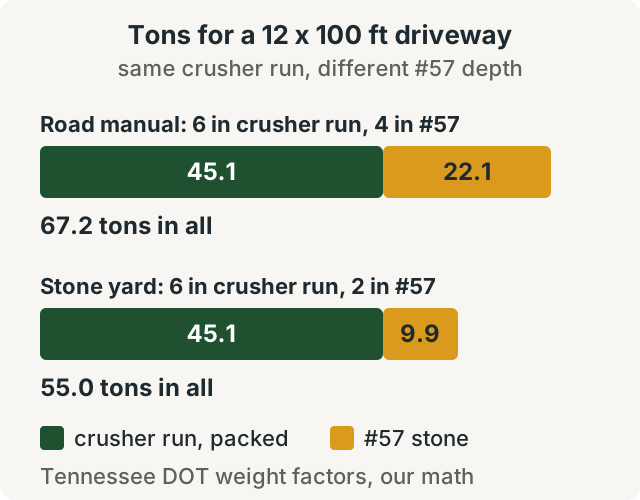
The road manual order is about 12 tons heavier, and all of it is #57. The crusher run is 45.1 tons either way; the #57 goes 4 inches deep and packed instead of 2 inches and loose. The stone yard order has no #57 below at all, and on firm, dry ground we’d call that a fair build. On ground that stays wet, the #57 base is the drainage layer. Maine keeps its base at 7% fines or less “to allow for subsurface drainage.”
#57 cost more than crusher run in the one public price list we found. In Roanoke County’s April 2024 bid, all three bidders priced #57 above clean crusher run, by 29 to 34%: $20.00 against $15.50, $27.00 against $21.00, and $31.40 against $23.40 (the bid sheet doesn’t print a unit for these lines). That’s one county’s bid. Get your own quote per stone.
Crown it, or the best stone won’t help
Gravel only sheds water if the middle is higher than the edges. Maine’s manual uses 1/2 inch of crown per foot of road width on level or gently sloping roads, and up to 3/4 inch on steeper stretches. Culpeper asks for a cross slope of at least 4 percent. Close enough. Half an inch per foot is about 4.2%. On a 12 foot driveway crowned down the center, that’s the middle 3 inches higher than each edge.
Before you order
Your yard’s numbers beat Tennessee’s. Ask what a yard of their crusher run weighs, since Gravelshop’s crusher run is 2,410 lb and Smoky Mountain gives 2,800 to 3,000, which is 16 to 24% more (more seller figures are in our post on what a yard of gravel weighs), and type it into the custom weight box of the gravel calculator for cubic yards and tons. Each layer is its own run through the calculator, and only the packed ones get a compaction setting. For a top-up of 2 to 4 inches loose, the 12 x 100 driveway page already has this size worked out, and paver and concrete driveway base depths are in the driveway and patio base guide.