Gravel calculators compared: compaction is where the orders split
Three of the five gravel calculators we checked on October 6, 2026 never mention compaction, and that’s the step that leaves you short on a packed base. The volume math is the same on all five: length times width times depth, divided by 27 for cubic yards. A 12 by 20 foot pad at 4 inches comes out at 2.96 cubic yards everywhere.
Packed gravel takes up less room than loose gravel, though, so for a base under pavers, a shed or a slab you have to buy more than the finished depth suggests. And one of the two that do says gravel shrinks 30%, then tells you to add 30%. Those two numbers don’t match: add 30% to the bare volume and you’ll end up about 9% short.
Five calculators side by side
| Calculator | Weight used | Compaction | Extra |
|---|---|---|---|
| Inch Calculator | 1.4 to 1.7 tons per cu yd | Says it can cut volume by 30%, then says to add 30% | 10% |
| CalculatorSoup | Presets by stone, like 2,835 lb per cu yd for #411 | Optional field, “typically 5-30%” | Optional, 5 to 15% |
| Omni Calculator | 105 lb per cu ft | Not mentioned | “Buy some extra” |
| Calculator.net | Presets for gravel, gravel with sand and sand, or your own | Not mentioned | Not mentioned |
| Angi | Not stated | Not mentioned | Not mentioned |
Inch Calculator’s page was modified April 30, 2026, CalculatorSoup’s updated February 2, 2026, and Angi’s July 8, 2026. Omni and Calculator.net show no date.
How much gravel shrinks when you pack it
Quikrete’s patio instructions spread 5 inches of loose gravel and tamp it to 4. Penn State’s Center for Dirt and Gravel Road Studies places its road surface aggregate 8 inches deep and compacts it to 6.
As “how much more to buy”, that’s 25% for Quikrete (5 is a quarter more than 4) and 33% for Penn State (8 is a third more than 6). They’re measuring different things: Penn State’s numbers are for a road surface aggregate, Quikrete’s for a patio base. We haven’t found a source that explains the gap.
The 30% trap
A 30% shrink and a 30% allowance aren’t the same thing. Inch Calculator says compacting “can cause a reduction in 30% of the total volume”, then says “you may need an additional 30% of material after factoring in your overage”. If gravel really loses 30% of its volume, what’s left is 70% of what you spread. To finish at 4 inches you need 4 ÷ 0.7 = 5.7 inches loose, which is 43% more. Add 30% to the bare volume and you land at about 91% of your target. On a 4 inch base, that’s 3.6 inches. Inch’s order of steps, its 10% extra and then 30% on top, comes to 1.1 × 1.3 = 1.43, which happens to cover the 43%. But then the 10% meant for spills and uneven ground is used up.
Quikrete’s numbers show the same slip from the other side: going from 5 inches to 4 is a 20% shrink, but you need 25% more gravel. We’d ignore shrink percentages and work from loose and packed depths.
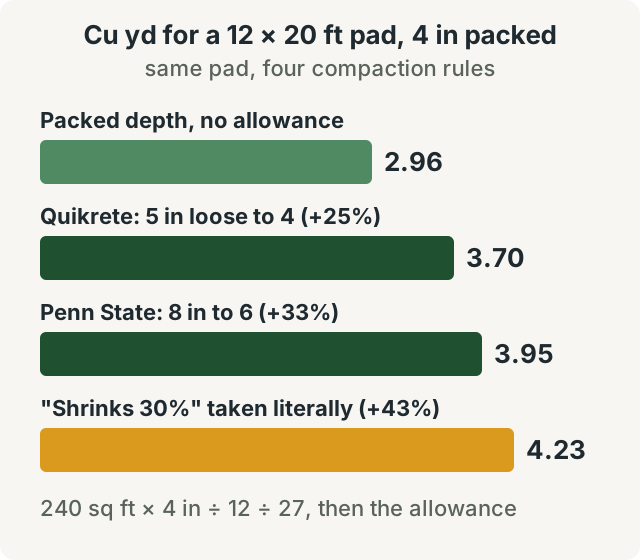
On that 12 by 20 pad, the gap between ignoring compaction and Penn State’s rule is about a cubic yard. At 105 lb per cubic foot, that’s 1.4 tons of stone you’d be short, or a second delivery fee.
Weight is the other swing
If your yard sells by the ton, the weight per yard matters as much as the volume. Inch Calculator’s range of 1.4 to 1.7 tons per cubic yard is wide. On 3.7 cubic yards, it’s the difference between 5.2 and 6.3 tons.
Omni and our own calculator use 105 lb per cubic foot for dry gravel, from Engineering ToolBox. That works out to about 1.42 tons per yard, the low end of Inch’s range. Penn State’s ordering formula for its road aggregate (0.04 tons per square foot, spread 8 inches deep) works out to about 1.62 tons per yard by our math.
Ask your supplier what one cubic yard of that exact product weighs, and put it into the calculator.
Which one to use
For loose gravel on a path or a driveway top-up, compaction doesn’t apply. Any of the five will do; just add the extra it suggests (Inch Calculator suggests 10%, and CalculatorSoup’s optional field runs 5 to 15%).
For a packed base, use a calculator that lets you set compaction, or do it by hand: multiply your finished depth by 1.25 (Quikrete’s patio base) or 1.33 (Penn State’s road aggregate). CalculatorSoup has a compaction field. So does our gravel calculator, with both rules as presets.
,_compactor.jpg)
If you’re not sure what finished depth to aim for, our guide to gravel for a driveway or patio base has the depths by project. Then enter the size and depth in the gravel calculator, pick a compaction rule and your stone, and it tells you the loose depth to spread along with cubic yards and tons. For pavers, the paver calculator adds the bedding sand and the paver count.