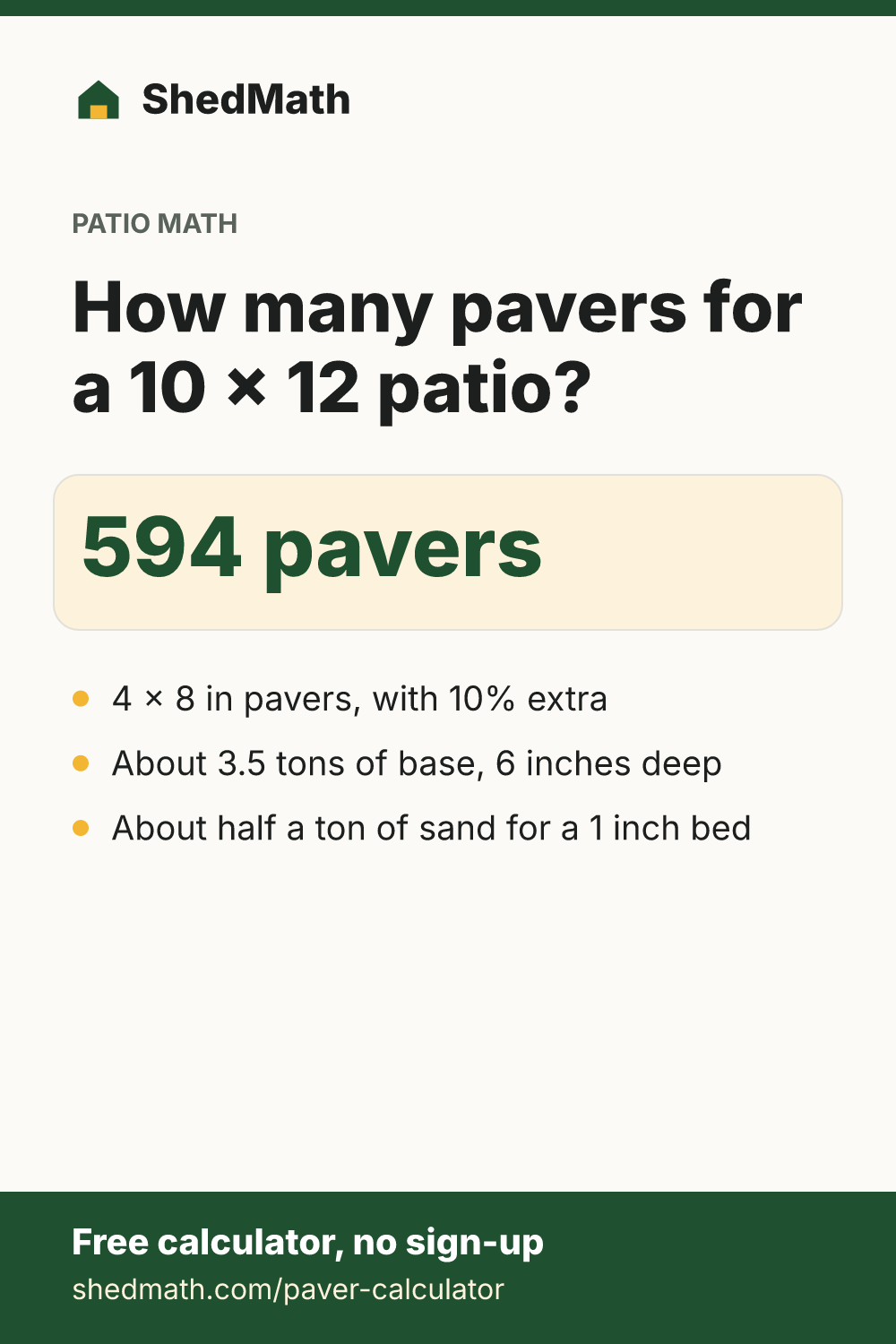
Plan on 594 pavers of 4 × 8 in for a 10 × 12 ft patio: that's 540 plus 10% for cuts. Put in your own area and paver size and you'll also get tons of base gravel, bedding sand and feet of edging.
Quick answers
Unilock calls for 6 to 8 in of compacted 3/4 in crushed gravel base under patios and walkways, and 10 to 14 in under driveways.
The bedding layer is a 1 in bed of coarse sand, or of 1/8 in chip stone (Unilock). For a 120 sq ft patio that's 10 cu ft of sand, roughly half a ton.
How to use the paver calculator
A rectangle or circle goes straight in, in feet. For any other shape, add up the pieces yourself and choose "I know the square feet".
Pick your paver size, or enter the real dimensions from the supplier's sheet. Many pavers have built-in spacer bars, so you don't need to add a joint.
Set the base depth for your project. Unilock's finished depths are 6 to 8 in for foot traffic and 10 to 14 in for cars. The calculator doesn't add for compaction, so enter about a quarter more (Quikrete's patio base goes down 5 in loose and packs to 4).
The formulas
Pavers = area (sq ft) × 144 ÷ (paver length × paver width in inches), plus the extra, rounded up.
Base and sand = area × depth (in) ÷ 12 cubic feet, then ÷ 27 for cubic yards. Weight uses Engineering ToolBox values: 105 lb per cu ft for dry gravel and 97 for dry sand. Stone varies, so if the yard tells you what theirs weighs, use that.
Worked example: a 10 × 12 ft patio with 4 × 8 in pavers
120 sq ft ÷ (32 sq in ÷ 144) = 540 pavers. With 10% extra: 594 pavers. A 6 in base is 60 cu ft; with 10% extra that's 2.44 cu yd, about 3.5 tons. A 1 in sand bed is 10 cu ft; with extra, 0.41 cu yd, about half a ton. Edge restraint: 44 ft.
Pavers per 100 sq ft
No extra added.
Paver size
Pavers per 100 sq ft
4 × 8 in (brick / holland)
450
6 × 6 in
400
6 × 9 in
267
12 × 12 in
100
16 × 16 in
57
24 × 24 in
25
Save this example
The worked example as a card you can save to Pinterest or print.
Common questions
How many pavers do I need for a 10 × 10 patio?
100 sq ft. With 4 × 8 in pavers that's 450 pavers, or 495 with 10% extra. With 12 × 12 in pavers it's 100, or 110 with extra. For 6 × 9 in pavers, 267 before extra.
How much gravel do I need under pavers?
At 6 in, the low end of Unilock's patio range, a 10 × 12 ft patio needs 60 cu ft (2.2 cu yd), about 3.2 tons before extra. Gravel packs down, so order more than the finished depth. Quikrete's patio base goes down 5 inches loose and finishes at 4.
How much sand goes under pavers?
One inch, screeded (leveled with a straight board). Unilock uses coarse concrete sand, or 1/8 in chip stone over a clear stone base. Don't use the bedding layer to fix low spots in the base; fix the base instead.
How much extra should I order for cuts?
Straight patterns on rectangles need the least. Curves, circles and herringbone patterns need more cuts. The calculator defaults to 10%. Ask your supplier whether you can return unopened pallets or full bundles.
Do I need edge restraints?
Yes. Unilock calls edge restraints a critical part of the installation because they stop pavers from shifting sideways. The calculator shows the perimeter so you can buy edging; skip any edge that sits against a house wall or a concrete slab.
The site only keeps what it needs to work, like your light or dark theme. With your OK we'd also count visits and, later, show ads that help keep the calculators free. Those stay off unless you say yes.How we use cookies