Retaining wall blocks per square foot: why area math comes up short
A small 4 inch wall block covers about a third of a square foot, so you need roughly 3.1 of them per square foot of wall. The big 8 by 18 inch blocks are close to 1 per square foot. That’s the kind of figure pallet listings give, and it gets you close. Not exact, though. Nobody builds a wall in square feet: you build it in whole courses of whole blocks, and on the 20 foot garden wall below that adds as much as 12% to the count, depending on the block.
Below are ten blocks you can buy at a big-box store or a dealer, with the numbers from each block’s spec sheet, checked on October 7, 2026.
Ten blocks, by the numbers
Face size is height by length, the part you see. Blocks per square foot is our math from that face size (or the sheet’s own figure where it gives one). Weights are per block.
| Block | Face (in) | Blocks per sq ft | Per pallet | Sq ft per pallet | Weight |
|---|---|---|---|---|---|
| Pavestone 12 in Retaining Wall #811 | 4 × 11.63 | 3.10 | 144 | 46.6 | about 21.6 lb |
| Pavestone RockWall Small | 4 × 11.63 | 3.10 | 144 | 46.5 | about 21.2 lb |
| Pavestone RockWall Medium | 6 × 7.75 | 3.10 | 96 | 31 | about 19.4 lb |
| Pavestone RockWall Large | 6 × 17.44 | 1.38 | 48 | 34.9 | about 40.4 lb |
| Lowe’s 4 in × 11.5 in basic block | 4 × 11.5 | 3.13 | not listed | not listed | 22.5 lb |
| Lowe’s 6 in × 16 in basic block | 6 × 16 | 1.5 | not listed | not listed | 42 lb |
| Versa-Lok Standard (Rochester Concrete Products) | 6 × 16 | 1.5 | 40 | 26.7 | 82 lb |
| Belgard Diamond Pro (Tacoma plant) | 8 × 18 | 1.0 | 45 | 45 | about 74 lb |
| Belgard Diamond Pro Air (Mid-Atlantic plants) | 8 × 18 | 1.0 | 48 | 48 | 54 lb |
| Allan Block AB Stones (Shaw Brick sheet) | 7.5 × 17.625 | 1.09 | 40 | 37 | 74.8 lb |
The Pavestone weights and the Diamond Pro weight are ours: pallet weight divided by the count. Pavestone’s sheets say their weights are approximate and don’t include the wooden pallet. Lowe’s notes that size, weight and availability “may vary by region and by manufacturer,” and the same goes for every block here. Belgard and Allan Block sheets differ by plant (the ones we found are from Tacoma, the Mid-Atlantic and Nova Scotia), so ask for the sheet from the plant that supplies your store.
Count it the way you’d build it
Take a 20 foot wall that stands 2 feet above the ground with 6 inches of block buried, which is how Western Interlock’s install guide sets the first course. That’s 30 inches of block, 20 feet long, or 50 square feet of face.
Now count it the way you’d lay it. With 8 inch blocks, 30 inches isn’t a whole number of courses: you need 4, and 4 courses are 32 inches tall. Each course is 240 inches long, and 240 ÷ 18 = 13.3, so you need 14 blocks per course, with a cut at the end. That’s 56 blocks, not 50.
| Block | Count by area (50 sq ft) | Count by courses | Difference |
|---|---|---|---|
| Pavestone RockWall Small, 4 in | 155 | 168 (8 courses × 21) | +8% |
| Pavestone RockWall Large, 6 in | 69 | 70 (5 × 14) | +1% |
| Belgard Diamond Pro, 8 in | 50 | 56 (4 × 14) | +12% |
| AB Stones, 7.5 in (Shaw Brick size) | 55 | 56 (4 × 14) | +2% |
| Versa-Lok Standard, 6 in | 75 | 75 (5 × 15) | 0% |
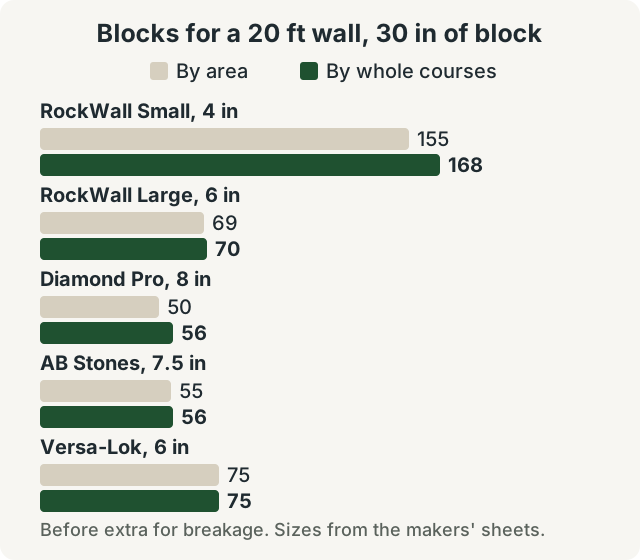
The gap comes from rounding twice. Courses have to come out whole, so a wall that falls between two courses gets the taller one. And the last block in each course gets cut, but you still buy it. Versa-Lok happens to fit this wall on both counts (30 ÷ 6 is exactly 5, 240 ÷ 16 is exactly 15), so area and courses agree. Diamond Pro misses on both.
You can sometimes put that extra height to use. Four courses of an 8 inch block come to 32 inches, so you could bury 8 inches instead of 6 and keep 24 showing. Check your block maker’s guide first. Either way you’re buying the fourth course, since three only reach 24 inches. Corners and ends that turn back into the slope aren’t in these counts, so add those blocks separately.
Then add something for breakage and cuts. Our retaining wall calculator counts courses and blocks per course the same way and adds 5% on top, so for the Diamond Pro wall above it says 59.
Listing numbers that mislead
The “12 inch” block is 11.63 inches. Pavestone’s own sheet for its “12IN RETAINING WALL” lists it as 4 inches high, 6.75 long and 11.63 wide, and its pallet coverage only works out if the 11.63 inch side is the face. The Lowe’s basic block is 11.5. A true 4 by 12 block would need exactly 3 per square foot. These need 3.1, about 3% more. On a small wall that’s a block or two; on a long wall it’s enough to leave you short.
A “1 sq ft” block can be smaller, too. Allan Block lists AB Stones at 8 by 18 inches and “1 sq ft. approx.” The sheet from Shaw Brick, a Nova Scotia plant that makes AB Stones, gives the actual block as 17.625 by 7.5 inches, which works out to 0.92 square feet. Its pallet of 40 covers 37 square feet, not 40. Order a 100 square foot wall at one block per square foot and you’d be about 9 blocks short. That’s one plant’s sheet; yours may be closer to the nominal size, which is exactly why it’s worth asking for it.
Then there’s the dealer listing that gives a block’s top as its coverage. One Belgard dealer, Ernest Maier, lists the 8 by 18 by 12 inch Diamond Pro at “1.5 sf per unit.” That’s 18 × 12 = 216 square inches, the footprint the block sits on. The face is 8 × 18 = 144 square inches, 1 square foot, and Belgard’s own sheet puts 45 blocks on a 45 square foot pallet. Read the dealer number as coverage and you’d buy two thirds of the block you need.
Weight: what the truck and your back carry
Per square foot of finished wall, these blocks range from about 54 pounds (Diamond Pro Air) to about 123 (Versa-Lok Standard, 82 pounds a block at 1.5 per square foot). The small Pavestone blocks come in around 67, and AB Stones at Shaw Brick’s numbers around 82. For the 20 foot wall above, counting the 5% extra, that’s 74 RockWall Large blocks at about 40.4 pounds, roughly 3,000 pounds, or 79 Versa-Lok blocks at 82 pounds, roughly 6,500.
The 4 inch blocks weigh about 21 to 22.5 pounds each. The 8 inch blocks and Versa-Lok run 54 to 82 pounds each: fewer lifts, much heavier ones. And if a pallet is going on your driveway or into a pickup, don’t plan around the printed pallet weight alone. Belgard’s Mid-Atlantic sheet for Diamond Pro Air lists 48 blocks at 54 pounds each, which is 2,592 pounds, but gives the pallet weight as 2,004. They can’t both be right. Ask the yard what a loaded pallet weighs.
Height ratings by block
Small blocks get low ratings. Lowe’s says its 4 inch basic block is for “retaining walls up to 2’ high” and its 6 by 16 inch block for walls “up to 3 feet high.” Belgard’s sheet says Diamond Pro gravity walls go “up to 4 feet high,” and the Diamond Pro Air sheet says “up to 3’ 4” high,” both including the buried course. Those are the makers’ limits before soil, slope and anything parked above the wall come in. Our guide on how tall a retaining wall can be without an engineer walks through the code line, the permit line and the soil charts.
If you’re capping the wall, Belgard’s Tacoma sheet puts 54 universal caps on a pallet covering 67.5 linear feet, which is 1.25 feet per cap. Our calculator counts caps at the block’s length: 14 for the 20 foot wall of 18 inch blocks, before extra. Caps 1.25 feet long need 16, so add a couple.
Pick one of the three blocks in the retaining wall calculator (RockWall Large, RockWall Small or Diamond Pro), or choose a custom size and enter the face height and length from your own store’s sheet. It counts whole courses, adds 5%, and gives you the caps, the footing and drainage gravel, and the drain pipe in the same pass.