How many bags of concrete in a yard? We checked two calculators
It takes 45 bags of 80 lb mix to make a cubic yard. An 80 lb bag of standard premixed concrete makes about 0.60 cubic feet, and a cubic yard is 27 cubic feet, so 27 ÷ 0.60 = 45 bags. Quikrete and Sakrete both print that yield on their data sheets.
Online calculators don’t all agree. On October 5, 2026, we checked Inch Calculator and Omni Calculator against those data sheets. Inch’s table matched, though one line in its FAQ says 45 bags of 90 lb, where its own table and the math say 80 lb. Omni is off by 6 bags a yard, and its own page contradicts itself.
What the bag makers say
These are the yields printed on the technical data sheets, which are the spec documents manufacturers publish for each product they sell. Quikrete calls its yields approximate. Sakrete’s sheet just lists them.
| Bag | Yield per bag | Bags per cubic yard | Data sheet |
|---|---|---|---|
| 40 lb | 0.30 cu ft | 90 | Quikrete, Sakrete |
| 50 lb | 0.375 cu ft | 72 | Quikrete 5000 |
| 60 lb | 0.45 cu ft | 60 | Quikrete, Sakrete |
| 80 lb | 0.60 cu ft | 45 | Quikrete, Sakrete |
| 90 lb | 0.66 cu ft | 41 | Sakrete |
Sources: Quikrete Concrete Mix 1101, Quikrete 5000 and Sakrete High-Strength Concrete Mix data sheets. Bags per cubic yard is 27 divided by the yield, rounded up.
For Quikrete and Sakrete’s standard mixes, every 20 lb makes about 0.15 cubic feet of concrete.
What the calculators say
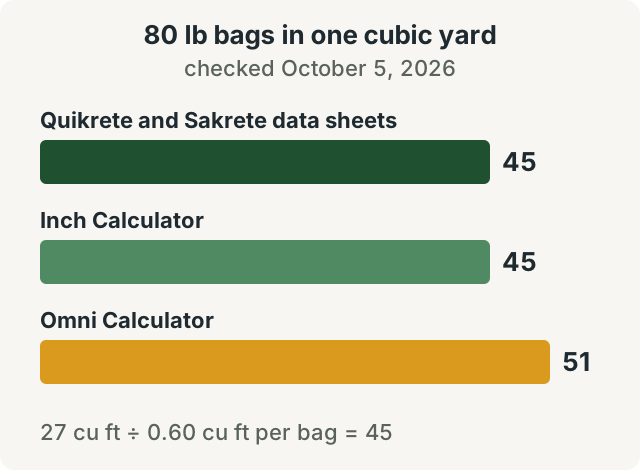
Inch Calculator says it takes 45 bags of 80 lb or 60 bags of 60 lb to fill a cubic yard. Those match the data sheets. Its 50 lb figure is 75 bags, a little above the 72 you get from Quikrete’s 0.375 cubic feet per bag.
Omni Calculator’s concrete calculator says an 80 lb bag yields about 0.53 cubic feet, and its table lists 51 bags of 80 lb per cubic yard (and 67 of 60 lb, 81 of 50 lb, 101 of 40 lb). The page also says that dividing 27 by 0.60 gives 51 bags. It doesn’t: 27 ÷ 0.60 is 45. Divide 27 by 0.53 and you get 50.9, which rounds to 51. So the table follows the 0.53 figure, and the 0.60 in that sentence looks like a leftover.
We couldn’t find 0.53 cubic feet on the Quikrete or Sakrete data sheets for their standard 80 lb mixes.
What 6 extra bags a yard adds up to
On one cubic yard, 51 instead of 45 is 6 extra bags, or 480 lb of dry mix you carry and pay for.
Take a 10 by 10 foot patio, 4 inches thick. That’s 33.3 cubic feet.
| Method | 80 lb bags |
|---|---|
| Data-sheet yield (0.60), no extra | 56 |
| Data-sheet yield (0.60), plus 10% extra | 62 |
| 0.53 yield, no extra | 63 |
| 0.53 yield, plus 10% extra | 70 |
To be fair to Omni, 0.53 isn’t a disaster on its own: it already builds in about 13% extra without saying so. If you take that number and then add a waste allowance on top, you’re buying twice. On this patio, that’s 8 bags more than the 62 you need.
We’d rather show the extra openly. Use the real yield, then add your own allowance. Duke City Redi-Mix, a ready-mix plant, suggests 10% for waste and uneven ground, and that’s the default in our calculator.
Why the label is still “approximately”
Quikrete calls its yields approximate, and Sakrete says its water amounts are only a starting point. The volume you get depends on how much water goes in and how well the mix is packed into the form. That’s one reason to keep the 10%. Running out halfway through a pour is worse than having three bags left over.
Before you buy:
- Read the bag. Some specialty mixes, such as lightweight or fast-setting ones, have their own yields printed on them. Quikrete’s fast-setting mix, for example, comes in 50 lb bags at about 0.375 cubic feet.
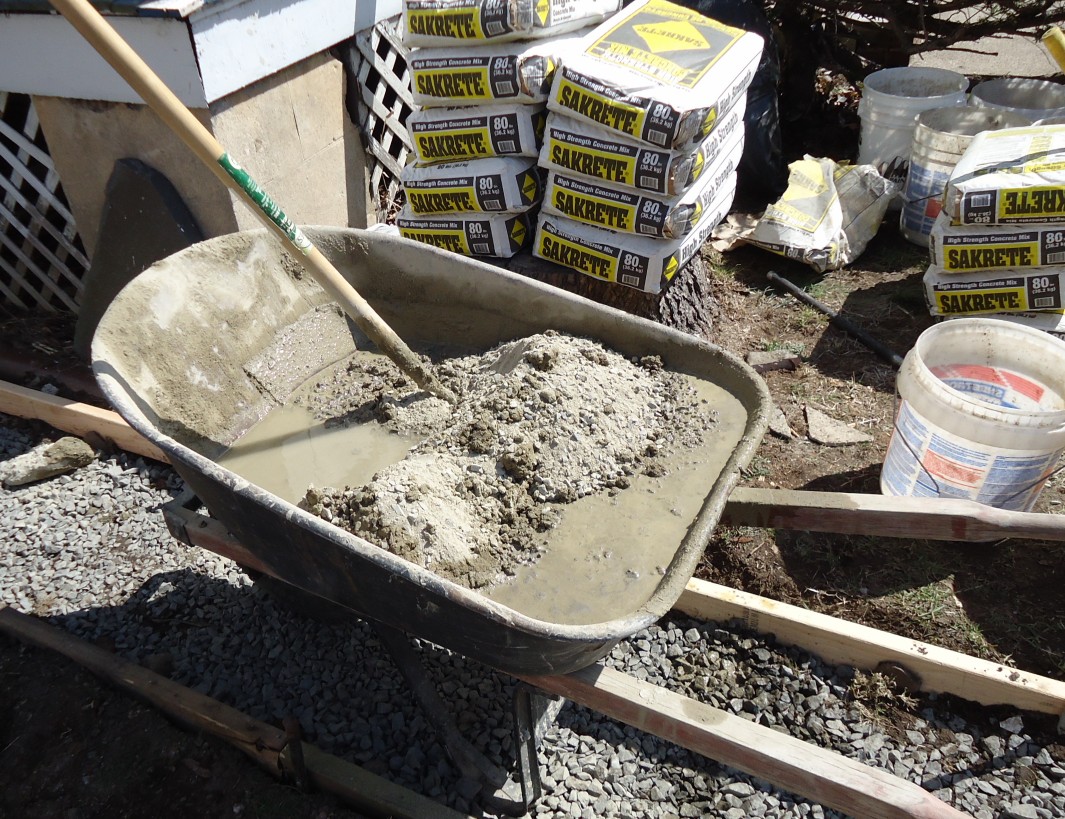
- Think about whether you want bags at all. At about 1 cubic yard you’re looking at 45 bags, which is 3,600 lb to lift and mix. Past that, get a ready-mix quote. Duke City Redi-Mix sells in quarter-yard steps with a one-yard minimum, and Townsend Concrete lists minimums and short-load fees, so compare both prices.

Bags or a truck for your job
Our concrete calculator uses the data-sheet yields above, adds the allowance you pick, and shows 40, 50, 60 and 80 lb bag counts next to a ready-mix order rounded up to the next quarter yard. That side-by-side is the quickest way to see which side of the bag-or-truck line your slab falls on.