How cold is too cold to pour concrete? Rules for a fall pour
Look at the forecast for the two days after the pour, not the morning you pour. Fresh concrete has to reach 500 psi before it freezes, and the American Concrete Institute’s cold-weather guide (ACI 306R-16) says most well-proportioned mixes get there in about 48 hours if they’re kept at 50°F. Freezing before that point is what ruins a slab.
ACI calls it cold weather when the air “has fallen to, or is expected to fall below, 40°F” during that protection period. At or below that line you need a plan for keeping the slab warm. If a freeze is forecast within 48 hours, or the ground is already frozen, wait.
What early freezing does
Fresh concrete is full of water. If that water freezes before the mix has hardened, it expands and breaks up the paste from the inside. The National Ready Mixed Concrete Association’s cold-weather sheet (CIP 27) says the potential strength of frozen concrete “can be reduced by more than 50%.” You won’t see it on day one. It shows up later as a surface that flakes, cracks or wears through.
Once it passes 500 psi, ACI says it can take a single freeze-and-thaw cycle without damage. Repeated cycles are another matter: NRMCA’s CIP 27 says to protect concrete from those until it reaches 3,500 psi.
How much cold slows things down
Cement hardens through a chemical reaction, and cold slows the reaction down. CIP 27 gives a rule of thumb: every 20°F drop in the concrete’s own temperature roughly doubles the setting time. Run that rule across the range a fall pour sees and you get this:
| Concrete temperature | Setting time compared with 70°F |
|---|---|
| 70°F | 1x |
| 60°F | about 1.4x |
| 50°F | 2x |
| 40°F | about 2.8x |
That’s our math from NRMCA’s rule, so treat it as rough. It lines up with Sakrete, which says set time at 40°F is more than double what you’d get at 70°F. What counts is the concrete’s own temperature, which is why warm mix water helps.
You’ll wait longer for the bleed water (the thin film that rises after screeding) to dry off before you can trowel, so plan on a longer day. And the slab sits weak for more hours, which is when a cold night does its damage.
Should you pour this week?
Check the forecast lows for the day you pour and the two to three days after, then match them here.
| Forecast lows, next 3 days | What to do |
|---|---|
| Above 50°F | Pour as usual. Cover with plastic so it doesn’t dry out. |
| Above 40°F, up to 50°F | Pour, and put insulated blankets on for the first nights. |
| At or below 40°F | ACI’s cold weather. Insulate for at least 3 days, or wait. |
| Freezing within 48 hours, or frozen ground | Don’t pour. |
The 40 to 50°F row is our call. ACI doesn’t treat those nights as cold weather, but its 48-hour figure and Sakrete’s 3-day rule both assume the concrete is held at 50°F, and lows in the 40s won’t do that on their own. Blankets are cheap compared with a slab that scales.
The 3-day figure is from Sakrete’s cold-weather tips for small projects (written by Sakrete’s Dirk Tharpe, January 2021), which cites ACI 306.1-90: protect fresh concrete “for at least 3 days after placement, maintained at 50°F.” The same piece says to keep it protected until it reaches 500 psi. The USDA’s engineering sheet on cold-weather concreting says plainly that concrete “will not be placed on frozen subgrade.”
Fast-setting mix buys you a day
The same USDA sheet has a table of how long to protect concrete, depending on the cement. For a slab that’s outdoors but carrying no load yet, it lists 3 days with ordinary Type I or II cement and 2 days with high-early-strength cement (Type III, or 100 lb of extra cement per cubic yard).
So for a late pour, the mix matters. Sakrete’s tips name its 5000 Plus (more cement) and Fast Setting Concrete Mix (a quicker set) for cold-weather pours. If you’re buying bags in November, that’s the shelf to look at.
Protecting the slab
These steps come from Sakrete’s tips unless noted.
- Mix with warm tap water. Sakrete notes tap water “generally does not exceed 120°F.” Never boiling water, which makes the mix set too fast to work.
- Keep the mix as stiff as you can still work it (a low slump, in trade terms).
- Cover the surface. Insulated blankets, rigid foam board, or a layer of straw “12-inches or more” with plastic on top. Weigh the covers down so wind can’t get under them.
- Give the edges and corners extra cover. The USDA sheet calls them particularly vulnerable and says the insulation there should be about three times as thick as on the rest of the slab.
- Leave the forms on longer, anywhere from 1 to 7 days depending on how cold it gets.
- Take the covers off gradually. A sudden drop from warm blanket to cold air can crack the surface.
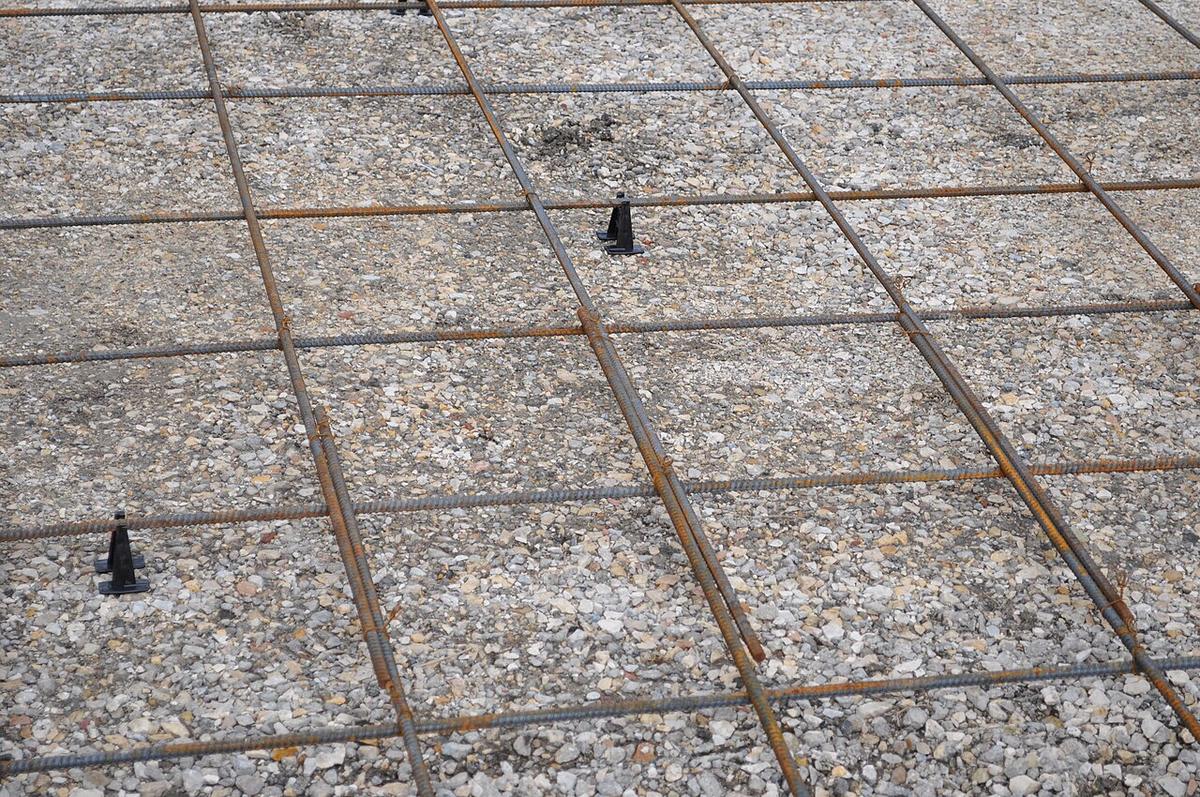
Don’t add antifreeze. Sakrete’s tips say never to put automotive antifreeze or windshield washer fluid in concrete. Calcium chloride is different: it’s a real set accelerator, but both Sakrete and CIP 27 cap it at 2% of the cement’s weight. Sakrete also says not to use chloride accelerators at all in concrete with steel in it, and the USDA sheet gives the reason: they corrode the reinforcing. If there’s rebar or wire mesh in your slab, leave it out.
Buy enough blanket to fold down over the forms on all four sides, and have it on site before the truck or the first bag.

Ordering ready-mix in the cold
A plant can do much of the cold-weather work for you. Ask for heated water or a cold-weather mix when you book. NRMCA’s sheet on surface scaling (CIP 2) also says concrete that will go through freezing and thawing must be air-entrained, meaning it has tiny air bubbles mixed in that give expanding ice somewhere to go. For severe exposure, like a driveway that gets salted, it gives 6 to 7% air. Ask the plant to confirm the mix has it.
The first winter
Fresh concrete keeps gaining strength for weeks. CIP 2 is blunt about deicing salt: don’t use calcium or sodium chloride on it “in the first year after placing the concrete.” We’d throw sand down for grip that first winter instead.
How late in the year is too late?
There’s no single date, because it depends on where you live. Look up your area’s average first fall freeze (your local National Weather Service office publishes it, usually on a frost and freeze page) and work backward from it. You want the pour followed by at least two or three days with lows above freezing, and ideally around 50°F.
When you’ve got a window, the concrete calculator tells you how many bags or how much ready-mix to order. The slab planner gives the whole shopping list, base and forms included, so nothing’s missing on pour day.