How deep should fence posts be? (And how much concrete)
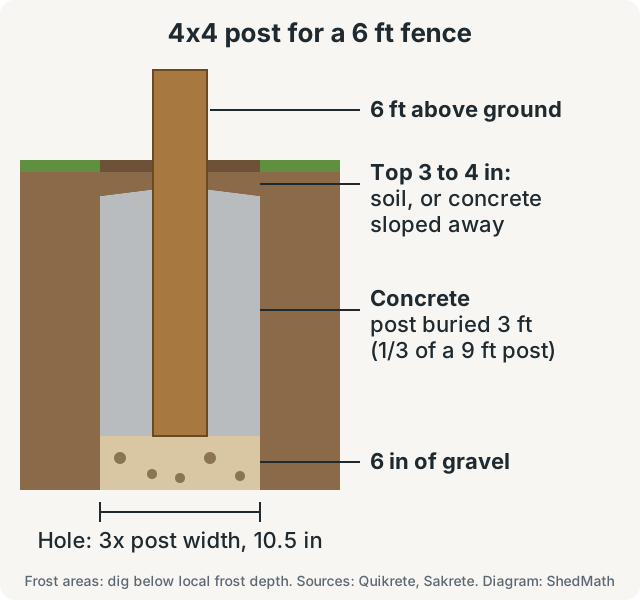
For a 6 foot fence, bury the posts 2 to 3 feet deep, with about 6 inches of gravel under each one. Where the ground freezes, the hole should go below your local frost depth. The exact number depends on whose rule you follow. The big manufacturers don’t agree with each other, and even Quikrete’s own documents differ a little.
The depth rules, side by side
| Source | Rule | For a 6 ft fence |
|---|---|---|
| Quikrete setting-posts guide (PDF) | 1/3 of the post’s total length, plus 6 in for gravel | 3 ft (a 9 ft post) |
| Quikrete Fast-Setting Concrete data sheet | Half the height above ground | 3 ft |
| Quikrete’s how-to page | 1/3 to 1/2 of the height above ground, plus 6 in | 2 to 3 ft |
| Sakrete project guide | About 1/3 of the height above ground | 2 ft |
The first two rules land on the same depth, which is less of a coincidence than it looks. If a third of the post is underground, the part above ground is the other two thirds, so the buried part is half of what’s above. A 6 ft fence needs 9 ft posts with 3 ft in the ground.
The fence calculator uses that 3 ft rule. It’s the deeper option, and it’s where the first two Quikrete documents agree.
_(2).jpg)
How wide to dig
Quikrete says the hole should be 3 times the width of the post. A 4x4 actually measures 3 1/2 by 3 1/2 inches (the Southern Pine Inspection Bureau lists the dressed sizes), so that’s about a 10 1/2 inch hole. Sakrete rounds up. Its guide calls for a 12 inch hole for a 4 inch post.
.jpg)
The frost line, if your ground freezes
When soil freezes it expands and can push a shallow post up out of the ground. This is called frost heave. A University of Wisconsin Extension guide, written for farm fencing, notes that posts set below the frost line are less likely to heave when the ground thaws in spring.
Quikrete’s guide says posts that hold up a structure, like a deck, must go at least 6 inches below the frost line. It doesn’t say that for fences. Hoover Fence, a fence supplier, does: check your local frost depth and dig at least 6 inches past it.
Building a deck on those posts? The joist size by span page covers the framing that sits on top.
There’s no single national number. The model building code has each town or county fill in its own frost depth (footnote b to the climatic design table in the International Residential Code; here’s one town’s filled-in copy). Call your local building department, or check its website for “frost depth.” In a cold place, that number can be deeper than the 2 to 3 feet above, and it wins.
Call 811 before you dig
811 is the US call-before-you-dig line. Call811.com says to call 811 or make an online request 2 to 3 days before you start, so the utility companies can mark buried lines. The details vary by state.
How much concrete per post
Every extra foot of depth takes more concrete. This table uses Quikrete’s 3x hole width, 6 inches of gravel, concrete stopping 3 inches below the surface, and 50 lb bags of Quikrete Fast-Setting Concrete Mix at about 0.375 cubic feet each, the yield its data sheet gives for slabs. For posts, the same sheet says two 50 lb bags will set a 4 inch post in a 10 inch hole 2 feet deep, so treat our counts as the safe side:
| 4x4 post buried | Concrete per post | 50 lb bags per post (rounded up) | Bags for 10 posts |
|---|---|---|---|
| 2 ft | 0.90 cu ft | 3 | 30 |
| 3 ft | 1.42 cu ft | 4 | 40 |
One extra foot of depth on a 10-post fence is 10 more bags. The concrete-per-post chart covers fences from 3 to 8 feet tall and 6x6 posts.
Setting the post, step by step
These steps follow Quikrete’s guide and the Fast-Setting Concrete Mix data sheet.
- Dig the hole to depth plus 6 inches, and 3 times the post’s width.
- Put 6 inches of gravel or crushed stone in the bottom for drainage.
- Stand the post in the center of the hole and hold it plumb (straight up and down).
- Pour the dry mix straight from the bag until it’s 3 to 4 inches below the top of the hole.
- Pour in water, about 1 gallon per 50 lb bag.
- The mix sets in 20 to 40 minutes. Wait 4 hours before putting heavy objects on the post.
Sakrete’s fast-setting mix only asks you to wait 30 minutes before putting any load on the post, so the two brands are far apart here. Follow the bag you bought.
Concrete to the top, or dirt?
Sakrete, Quikrete, a USDA researcher and a fence supplier don’t all agree.
- Sakrete says to slope the concrete down and away from the post, and warns that backfilling with dirt can make the post rot early.
- Quikrete’s how-to page has you stop the concrete 3 to 4 inches below ground level and backfill with soil once it has set.
- Grant Kirker of the USDA Forest Products Laboratory, writing in the Journal of Light Construction, cited a European study that compared concrete, gravel and dirt fill. Concrete lasted best. He also says to slope the top away from the post. That’s one study, mentioned in a short article, so it’s a hint at best.
- Hoover Fence says the opposite: stop the concrete 3 to 5 inches below the ground and fill the rest with dirt.
Sakrete sells concrete, and Kirker’s point rests on one study, so the evidence is thin either way. Our table, our steps and the fence calculator follow Quikrete and leave 3 inches for soil. If you’d rather bring the concrete up to the surface and slope it away from the post so rain runs off, you’ll need a little more concrete than the table shows.
Use posts rated for ground contact
Wood posts going in the ground need lumber treated for it. The American Wood Protection Association’s rating for this is UC4A, “ground contact, general use,” and the Journal of Light Construction lists fence posts as one of its examples. Check the tag. The rating should be on it, or stamped on the wood.
Put your fence length, post spacing and height into the fence calculator. It works out the posts, rails, pickets and bags of concrete for the whole run.