How much topsoil for a new lawn: 4 to 6 inches, minus what's there
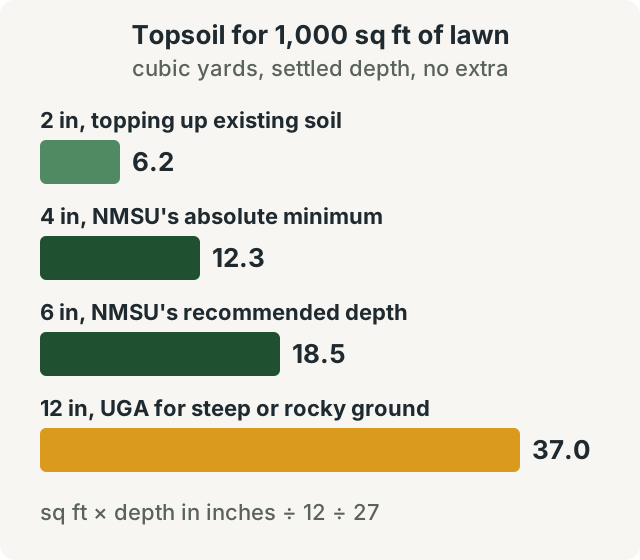
Grass wants 4 to 6 inches of good topsoil under it, measured after the soil has settled. On bare subsoil that’s 12.3 cubic yards for every 1,000 square feet at 4 inches and 18.5 at 6, before any extra for settling. But that depth is the total, and most yards already have some of it. Buy only the difference.
A calculator can’t see your yard, and that includes our topsoil calculator. It multiplies the area by whatever depth you type, as if the ground under the lawn were rock. New Mexico State’s turfgrass establishment guide (Bernd Leinauer, H-509) frames it the right way round. It says to add topsoil and organic matter until the total topsoil depth is 4 to 6 inches after firming. The Connecticut Agricultural Experiment Station’s fact sheet on starting a new lawn goes further: “With few exceptions, new top soil is rarely needed where an established soil exists.”
The depth every guide agrees on, and the one that doesn’t
Six extension sources, read October 28, 2026. The cubic yards are our math (square feet times depth in inches, divided by 12, then by 27), with nothing added for settling.
| Source | Depth for a new lawn | Cubic yards per 1,000 sq ft |
|---|---|---|
| Penn State Extension, updated Sept 2025 | “a minimum of 4 to 6 inches (firmed or settled depth)” | 12.3 to 18.5 |
| New Mexico State, H-509 | 4 inches “absolute minimum”, 6 or more recommended | 12.3, or 18.5 and up |
| University of Idaho, CIS 1062 | “at least 4 to 6 inches” | 12.3 to 18.5 |
| University of Nebraska, sod fact sheet | “a minimum depth of four inches” after a grade change | 12.3 |
| Purdue, AY-28-W | works the math for 6 inches: “Approximately 19 cubic yards” | 18.5 |
| UGA Extension, B 1533-2 | “at least 12 inches” on steep slopes or where rock outcrops exist | 37.0 |
Four inches is the lowest figure any of them gives. NMSU would go to six. Purdue’s 19 is our 18.5 rounded up, which is a fair way to order anyway. The outlier is Georgia’s 12 inches, which UGA gives only for steep slopes and rocky ground (more on that further down).
How much is already there?
Connecticut’s “rarely needed” has exceptions, and new houses are one of them. The fact sheet says newly built homes “may have had the surrounding top soil removed during construction,” and then you do need to bring it in. The same goes for raising a lawn to fix drainage.
Before you order, dig a few spade-deep holes across the lawn area and measure how much loose, workable soil sits over the hard stuff. That’s our suggestion, not an extension rule. Everything else hangs on it. If you’re regrading anyway, scrape your own topsoil off first and pile it nearby. Idaho’s guide says to save “the top 5 to 6 inches of soil for replacement later,” and NC State’s Forsyth County office says to remove 4 to 8 inches and keep it close.
A 4,000 square foot lawn, worked through
Say the lawn area is 4,000 square feet and you’re aiming for 6 inches of settled topsoil, NMSU’s recommended depth. Here’s the order depending on what the test holes show. We added our topsoil calculator’s default 10% for settling and used its 80 pounds per cubic foot for loam, from Engineering ToolBox.
| What’s there now | Topsoil to add | Cubic yards, with 10% | Tons |
|---|---|---|---|
| Nothing, stripped to subsoil | 6 in | 81.5 | 88.0 |
| 2 in of usable topsoil | 4 in | 54.3 | 58.7 |
| 4 in of usable topsoil | 2 in | 27.2 | 29.3 |
| 6 in or more | none | 0 | 0 |
Two inches already in place takes 27 yards, about 29 tons, off the order.
Zero still means work. Connecticut’s answer for a lawn with decent soil is to amend it rather than cover it: “2-3 yards of compost per 1,000 square feet,” fully mixed into the top 4 to 6 inches. For this lawn that’s 8 to 12 yards of compost.
The tons are softer than the yards, because the three sources we checked don’t agree on what a yard of topsoil weighs. Engineering ToolBox’s 80 pounds per cubic foot makes it 2,160 pounds. Hello Gravel’s topsoil page says about 2,200. Select Sand & Gravel, a Texas supplier, uses 1.2 tons, or 2,400 pounds, and gives a 1.1 to 1.3 ton range depending on moisture. Its quick reference table lists 5,000 square feet at 4 inches as 61.7 cubic yards and 74 tons; at 80 pounds a cubic foot the same yards are 66.7 tons. If your supplier sells by the ton, ask what their soil weighs. Buy wet soil by the ton and you’re paying for the water.
Hello Gravel’s FAQ calls a full truckload 18 tons. By that measure the “2 inches already there” order is more than three loads, and the bare-subsoil order is closer to five.
Bags only make sense for patching
Scotts sells its Premium Topsoil in 0.75 cubic foot bags, and its own lawn directions say to “spread 1-2 inches.” The bag says one covers 4 square feet at 2 inches. By our math it’s 4.5, so Scotts is rounding down in your favor.
Now run the 4,000 square foot lawn at 4 inches through that bag. It’s 1,778 bags, or 1,956 with 10% extra. That’s a lot of lifting. Even a 1,000 square foot section at 4 inches takes 445, or 489 with the extra. For filling low spots or top-dressing a few thin areas, bags are fine. For a new lawn, get it delivered in bulk.
Spread it in two lifts, not one
Connecticut’s fact sheet says new topsoil “should never just be placed on top of existing soil,” and that tilling part of it into the old soil first “assures better drainage from one soil to the next.” Purdue’s sod guide calls layering “a serious problem” for rooting, though it means sod soil laid over a different site soil. Penn State and Connecticut both blend the layers where they meet.
Penn State says that, ideally, 2 inches of the topsoil “should be incorporated into the upper 2 to 3 inches of the subsoil,” which it says can reduce compaction and improve drainage where the two meet. Connecticut splits the load. Spread half and till it into the existing soil to form “a transition zone.” Then spread the rest and till it into the first half. On the 4,000 square foot lawn starting from subsoil, that’s roughly 41 yards in each lift.
Nebraska says not to till wet soil, because it clods, and not to try fixing heavy clay by tilling in sand: it “will become even more compacted.” Purdue says to give the soil a week to settle before final grading, and that irrigation or a good rain speeds it up. Fill the low spots that hold water, then grade.
Steep or rocky ground needs more
Georgia’s 12 inches works out to 37 cubic yards per 1,000 square feet, double the 6 inch figure. On a slope steep enough to need it, ask whether grass is the right answer at all. Idaho’s guide suggests terraces to cut down steep slopes. If you go that way, our retaining wall calculator counts blocks, caps and gravel, and our guide to how tall a wall can be without an engineer covers where the code draws the line.
Then test what you’re buying. Connecticut warns that “Many so called top soils or loams are of very poor quality,” and says to have soil you’re thinking of buying tested in advance. Ask the supplier for a sample and get it tested before 80 yards of it arrive.
When you put your lawn into the topsoil calculator, enter the depth you’re adding, not the 4 or 6 inch total, and keep some extra for settling. None of the extension guides we read gives a percentage. Select tells customers to add 10 to 15%, and the calculator starts at 10. If the lawn isn’t one rectangle, the square footage calculator adds up the pieces, and its total goes in the “I know the square feet” box.