How much paint for a room? Two gallons, unless the walls say otherwise
Two gallons covers the walls of a 12 by 12 foot room in two coats, if they’re 8 feet tall, smooth, already painted and staying roughly the same color. That room has 384 square feet of wall. Take off 20 for the door and 12 for each of two windows, the sizes our paint calculator counts, and 340 are left to paint. Change what the walls are, though, and the same room can take 3, 4 or up to 8 gallons of paint, primer and filler before anyone touches the ceiling.
The can won’t warn you. Makers print one range and put the spread down to the wall.
Behr’s guide to how much interior paint to buy says a gallon of its Ultra or Premium Plus covers 250 to 400 square feet in one coat, and that a “porous, rough, textured, previously unpainted surface” may need more paint for extra coats. Kilz 2 primer claims 300 to 400 “depending on application method and surface porosity.” Sherwin-Williams’ paint calculator page says a gallon of paint “typically covers about 350-400 square feet.” None of the three makers’ pages we read on October 21, 2026 says how much more a textured wall takes.
So we worked it from the wall side. (For other room sizes with smooth walls, the paint calculator’s page has a table running from a 10 by 10 bedroom to a 16 by 20 family room.)
Same room, different walls
Every row below is the same 340 square feet, ceiling left out. The gallons are our arithmetic, using each source’s coverage and the rounding our paint calculator uses: it starts at 350 square feet a gallon and turns three spare quarts into a gallon.
| The walls | What goes on them | Gallons, by our math | What to buy |
|---|---|---|---|
| Smooth, painted, similar color | 2 coats of paint at 350 to 400 sq ft per gallon (Sherwin-Williams) | 1.70 to 1.94 | 2 gal of paint |
| New, bare drywall | 1 coat of primer at 200 to 400, then 2 coats of paint at 350 | 0.85 to 1.70 primer, 1.94 paint | 1 to 2 gal of primer, 2 gal of paint |
| Rough texture | 2 coats at 350, plus up to 50% | up to 2.91 | 2 to 3 gal of paint |
| Very dark to very light, no primer | 3 or 4 coats at 350 | 2.91 to 3.89 | 3 to 4 gal of paint |
| Bare concrete block, above ground | 1 coat of block filler at 75 to 100, then 2 coats of masonry paint at 250 to 400 | 3.40 to 4.53 filler, 1.70 to 2.72 paint | 3 1/2 to 5 gal of filler, 2 to 3 gal of paint |
The 50% comes from PaintCare, which collects leftover paint for recycling. Its buying guide says “you may need up to 50 percent more paint for rough textures,” because a textured wall has more surface to cover. The same page says going between very dark and very light colors can take “three or even four coats,” and that a tinted primer can cut the number of top coats. The block row is covered further down.
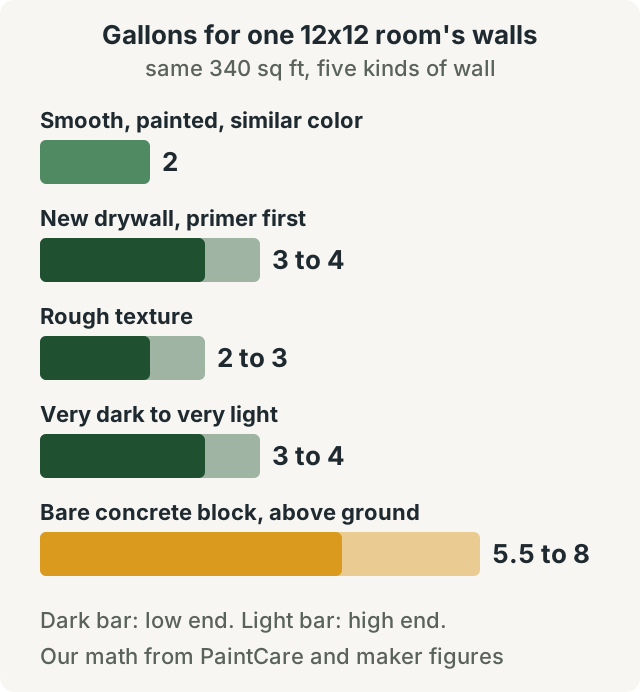
Only the first row is the 2 gallon room our calculator’s default answer describes. Every other wall can add a gallon or more. Bare block takes up to four times as much. Brand matters far less than any of that, and our paint coverage by brand post shows why the label numbers differ in the first place.
New drywall: put the extra coat in primer
PaintCare’s guide says “new, unprimed drywall, plaster, and bare wood absorb more paint and require more coats,” and that primer “prevents the top coat from being absorbed and reduces the number of coats needed.” Fine. But how much primer? The claims we found on October 21, 2026 don’t agree:
| Source | Coverage claimed (sq ft per gallon) | Gallons for 340 sq ft, one coat |
|---|---|---|
| Sherwin-Williams paint calculator page (primer in general) | 200 to 300 | 1.13 to 1.70 |
| Behr Drywall Plus Primer & Sealer | 250 to 400 | 0.85 to 1.36 |
| Valspar Prep Step Drywall Primer | 300 to 400 | 0.85 to 1.13 |
| Kilz 2 | 300 to 400 | 0.85 to 1.13 |
Our calculator assumes 250 for primer. That sits inside the Sherwin-Williams and Behr ranges and below the bottom of the other two, so it leans toward a little extra, which is where we’d want it on bare paper and joint compound. For this room it says a gallon and two quarts.
We’d always prime new drywall rather than count on a third coat of the good stuff. The primer is the coat that soaks in. After it, your color goes on a sealed wall, and Behr’s guide says less paint may be needed on “a smooth, primed or sealed surface.” One catch from Behr’s page: its drywall primer isn’t recommended under high-gloss paint, so check the primer’s label against your finish.
If the walls aren’t up yet, our guide to how many sheets of drywall a room takes counts the same 12 by 12 room, and the drywall calculator gives you sheets, mud and screws.
Texture and popcorn ceilings
None of the sheets we read gives a coverage figure for orange peel or knockdown. PaintCare’s “up to 50 percent” is the only number we found. We’d read it as a top end for planning, not a rule, and buy the extra in quarts rather than a whole gallon you may never open.
The 12 by 12 ceiling is 144 square feet. Home Depot’s listing for Behr Premium Plus ceiling flat paint gives up to 400 square feet a gallon and two coats in its specs, which by our math is 0.72 gallons, so one gallon. The listing calls it “ideal for use on textured, popcorn and acoustic-style ceilings,” and Behr’s own page for the paint says to use an acoustic ceiling roller cover or an airless sprayer on popcorn. Treat popcorn as a rough texture, add PaintCare’s 50%, and it’s 1.08 gallons. Call it a gallon and a quart. Small money. Behr’s page gives the same paint 250 to 400 square feet a gallon, and at 250 even a smooth ceiling lands in the same place.
Our calculator can add the ceiling, but it uses the wall coverage you typed. For a ceiling paint with a different rate, switch to “I know the wall area,” enter 144, set doors and windows to 0 and type the ceiling paint’s coverage.
Bare concrete block, above ground
This is where a room calculator misleads you, ours included. Benjamin Moore’s Block Filler 244 data sheet (footer 244 US 100424) gives a spread rate of 75 to 100 square feet a gallon, at 16.0 to 21.4 mils wet (a mil is a thousandth of an inch). Behr’s masonry, stucco and brick paint sheet (revised 06/2020) puts its paint on at 4.0 mils wet for 400 square feet and 6.4 mils for 250. So the filler goes on about two and a half to five times as thick. Filling the pores and voids in the block is its whole job.
Benjamin Moore then calls for two coats of finish on top, and warns that “extremely porous block, or block with large voids” may need a second coat of filler. Our table assumes one. For the 12 by 12 room that’s 3 1/2 to 5 gallons of filler before the 2 to 3 gallons of paint. The calculator, left at 350, would say 2 gallons.
Both sheets are for walls above ground: Benjamin Moore’s says the filler is “not recommended for below grade applications,” and Behr’s lists “above grade vertical surfaces.” So a basement wall with soil behind it is a different job, and the place to start is a masonry waterproofer’s own data sheet. We haven’t worked those numbers. Our table also pairs one maker’s filler with the other’s paint, which neither maker suggests. Behr’s own system for concrete block is one coat of its DryPlus Masonry Waterproofer No. 875, then two coats of the paint. The sheet lets the paint prime itself on concrete, brick and stucco, but not on block.
The Benjamin Moore sheet lists unglazed brick under “rough or pitted masonry,” so on its system bare brick works out like block. On Behr’s, brick can take two self-priming coats instead, so the brick number depends on which system you follow.
Trim usually takes a quart
Behr’s guide measures trim as its length times half a foot, since “the average trim width is six inches.” The 12 by 12 room has 45 feet of baseboard: 48 feet around the room, less the 3 foot door. Casing around the two 3 by 4 foot windows adds 28 feet. One side of a 3 foot by 6 foot 8 inch door adds about 16 more. Call it 89 feet, or about 45 square feet. Two coats is 89 square feet, and Sherwin-Williams says a quart covers 100. One quart, just. Casing on both sides of the door or a crown molding tips it to two.
Before you buy, set the paint calculator to the coverage printed on your can, then correct it for your walls: a primer coat for new drywall, a lower coverage for texture, and block worked by hand at the filler’s rate. If the room has a closet bump-out or a bay window, add up each wall’s area in the square footage calculator and enter the total as your wall area.